
The currency table on Fortrade's trading-conditions page, retrieved 14 November 2026, prints an EUR/USD row with an average spread of 2.5, a (*6) mark, initial margin of 0.5 percent, and leverage of 1:200. The symbol cell is EURUSD, the unit amount is 100,000, and the hours run from 22:01 to 21:59 GMT. The same page links its risk warning to a Mauritius disclosure naming Fortrade Mauritius Ltd. Read 2.5 as pips, keep the homepage's zero-commission line, and a same-day round turn on one standard lot is 25 US dollars of spread.
Two peer pages opened the same day put a smaller bill on the same ticket. Pepperstone Standard prints an average EUR/USD spread of 1.1, or 11 dollars on one lot, with a zero forex commission. IC Markets' Raw Spread page states 0.1 pips plus 3.50 dollars per lot per side, which is 8 dollars on the round turn. Fortrade's own homepage prints Zero Commission and then "Other fees apply." The card has no commission column, so 25 dollars is the spread under a pip reading, and overnight financing stays off a same-day close.
The rest of the page is a reading guide for that card. Every comparison uses figures taken from each broker's own site on 14 November 2026. Older reviews and third-party roundups stay out of the arithmetic.
How a pip, a point, and a round turn become dollars
A pip on EUR/USD is the fourth decimal place, 0.0001. The card's unit amount is 100,000, one standard lot, and one pip on that lot is 10 dollars. Two and a half pips are 25 dollars. One tenth of a pip is 1 dollar, which is the step the bar chart uses later.
A point is the smaller step, 0.00001 on a five-decimal EUR/USD quote, sometimes called a pipette. Ten points make one pip, and one point on a standard lot is 1 dollar. Pepperstone prints 0.1 and 1.1 on that pip scale. Fortrade's header is only "Average spread," and the cell prints 2.5 with no unit word beside it.
The dollar figure uses the pip reading because the same Fortrade column prints 800 on EUR/TRY, 250 on EUR/ZAR, and 3 on GBP/USD, the ordinary pip scale for those pairs. A point reading would shrink the EUR/USD bill to 2.50 dollars. The checklist asks the reader to confirm the unit on the live ticket, because the column header stays silent.
A round turn is the open plus the close. The spread is crossed once, because the entry fills on one side of the quote and the exit fills on the other. A per-side commission is counted twice on that round turn. Where the public line is zero commission, the spread is the explicit ticket, and daily financing stays off until the position is still open at the rollover.
Fortrade's long daily rate on EUR/USD prints minus 13, and the short rate prints 1. The footnote calls those swaps indicative and ties the example to 100 dollars, euros, or pounds, so the cells are a poor candidate for a silent conversion into dollars per lot. A same-day ticket leaves them off the bill. Wednesday night's close picks up a triple rollover, which the same footnote states in plain words.
What the Fortrade row actually contains
The row carries more than the spread. Initial margin is 0.5 percent and leverage is 1:200, with the professional-leverage field empty, so the page shows one leverage figure. The quote currency is USD and the hours run from 22:01 to 21:59 GMT. A separate bullet puts the open at 22:00 GMT in winter and 21:00 GMT in summer, and says the clock may change with British Summer Time.
The (*6) beside 2.5 points at this bullet: "This currency pair has a night spread from 20:55 to 06:00 GMT." The bullet names the clock and withholds the width. GBP/USD prints a night spread of 8 beside an average of 3(*6), USD/JPY prints 8 beside an average of 2(*6), and EUR/GBP prints "60 (21:55 - 22:55)". The EUR/USD night-spread field itself is empty, so on 14 November 2026 the width cell was blank on a card that can print a width.
Margin and leverage are the same ratio written two ways, because one divided by 200 is 0.5 percent. At an illustrative rate of 1.1000, a round teaching rate separate from any quote screen opened in this session, a 100,000-euro position is 110,000 dollars of notional, and 0.5 percent of that is 550 dollars of initial margin. The live ticket substitutes the screen price, so the dollar margin moves with the pair while the percentage stays put.
| Field on the EUR/USD row | What the card printed on 14 November 2026 |
|---|---|
| Average spread | 2.5(*6), column header carries no unit word |
| Night-spread cell | Empty, while the (*6) bullet names 20:55 to 06:00 GMT |
| Initial margin | 0.5 percent |
| Leverage | 1:200, professional-leverage field empty |
| Long daily rate | Minus 13, example tied to 100 of account currency |
| Short daily rate | 1, same example base |
| Unit amount | 100,000 |
| Hours (GMT) | 22:01 to 21:59 |
| Commission column | Absent; homepage heading is Zero Commission, and the next line says other fees apply |
| Dormancy | 10 dollars, 10 euros, or 10 pounds a month after six inactive months |
The homepage offers a free demo and describes "a platform designed for your trading journey," and a customer quote there calls the product a trading app. The schedule stores the symbol as mt4Symbol EURUSD, thin evidence of the screen the client clicks. The pages opened here name Fortrade's own platform and a demo. A separate raw account and a separate standard account are absent, so the scored tier is that single public currency row.
Two peers, scored on the same axes
The peers are Pepperstone's Standard CFD account and the Raw Spread account at IC Markets. Each figure comes from that firm's own page, opened 14 November 2026. The matrix scores spread, commission, legal entity, and platform, and it names the account tier.
Pepperstone's pairs-and-spreads page, at pepperstone.com/en/markets/forex/pairs-and-spreads, prints EURUSD with a Razor minimum of 0, a Razor average of 0.1, a Standard minimum of 1, and a Standard average of 1.1. Footnote 1 dates those spreads to 1 August 2026 through 31 August 2026, all sessions including rollover, and states a zero forex commission on the Standard CFD account. The pricing page, at pepperstone.com/en/ways-to-trade/pricing/, puts Standard fees apart from overnight funding inside the spread, while Razor commission starts from 3.50 dollars per lot per side. Standard is the scored tier because 1.1 and the zero commission are unconditional prints, and Razor stays off the bar chart. Account-currency detail on that Razor line is in the Pepperstone commission review.
The footer names Pepperstone Markets Limited, company number 177174 B, licence SIA-F217, licensed by the Securities Commission of The Bahamas at number 1 Pineapple House, Old Fort Bay, Nassau. The pairs page lists TradingView, MT5, MT4, cTrader, the Pepperstone platform, and a mobile app. Minimum deposit on the pricing page is 10 dollars.
IC's Raw Spread account page, at icmarkets.com/global/en/trading-accounts/raw-spread-account, states: "Our average EUR/USD spread is 0.1 pips, with only a small commission of $3.50 per lot payable per side." That average is said to hold across the 24/5 week on MetaTrader 4 and 5, beside a 1:5000 leverage line, with servers in Equinix NY4 in New York. The footer says IC and IC Markets Global are trading names of Raw Trading Ltd, Seychelles registration 8419879-1, regulated by the Seychelles Financial Services Authority under licence SD018.
The spreads table on icmarkets.com/global/en/trading-pricing/spreads, opened the same session, disagrees with that sentence. The EURUSD cells for Raw minimum, Raw average, Standard minimum, and Standard average print 0, 0.01, 0.8, and 0.1. A raw average of 0.01 is a tenth of the account-page 0.1, and a standard average of 0.1 sits below that column's own minimum of 0.8. The dollar chart follows 0.1 pips plus 3.50 dollars per side, and treats 0.01 as a conflicting print. A cTrader example there uses 3 dollars per 100,000 dollars of notional, which the IC Markets cTrader fee review follows on its own, off this MetaTrader line.
| Axis | Fortrade currency card | Pepperstone Standard CFD | IC Raw Spread, MetaTrader |
|---|---|---|---|
| EUR/USD spread | 2.5 average, unit unlabeled, (*6) night window with a blank width | 1.1 average and 1.0 minimum, August 2026 window including rollover | 0.1 pip average on the account page; the spreads-table raw-average cell prints 0.01 |
| Commission | Zero on the homepage, other fees apply, and the card has no commission column | Zero on standard FX, with overnight funding separate | 3.50 dollars per lot per side, 7 dollars round turn |
| Legal entity | Fortrade Mauritius Ltd, FSC SEC-2.1B GB21026472, on the linked risk file | Pepperstone Markets Limited, Bahamas, SIA-F217 | Raw Trading Ltd, Seychelles FSA SD018 |
| Platform | Fortrade's own platform and demo; symbol stored as mt4Symbol EURUSD | MT4, MT5, cTrader, TradingView, Pepperstone platform and app | MetaTrader 4 and 5 on this tier |
| Account tier | Single public currency row, with a demo beside it | Standard CFD, minimum deposit 10 dollars | Raw Spread, and the page also prints 1:5000 leverage |
| Same-day 1-lot bill | 25 dollars at the pip reading | 11 dollars | 8 dollars on the account-page average |
Pepperstone's 1.1 average already includes rollover hours, while Fortrade's 2.5 carries a night window whose width is unpublished. With rollover folded into Pepperstone's number, 1.1 pips remains under 2.5.
The same-day dollar bill
The chart is the same-day round turn on one standard EUR/USD lot, with the spread crossed once. Fortrade is 25 dollars, Pepperstone Standard is 11 dollars, and IC Raw is 8 dollars once a 7 dollar round-turn commission is added to a 1 dollar spread. Swap, the Wednesday triple rollover, and dormancy sit outside every bar.
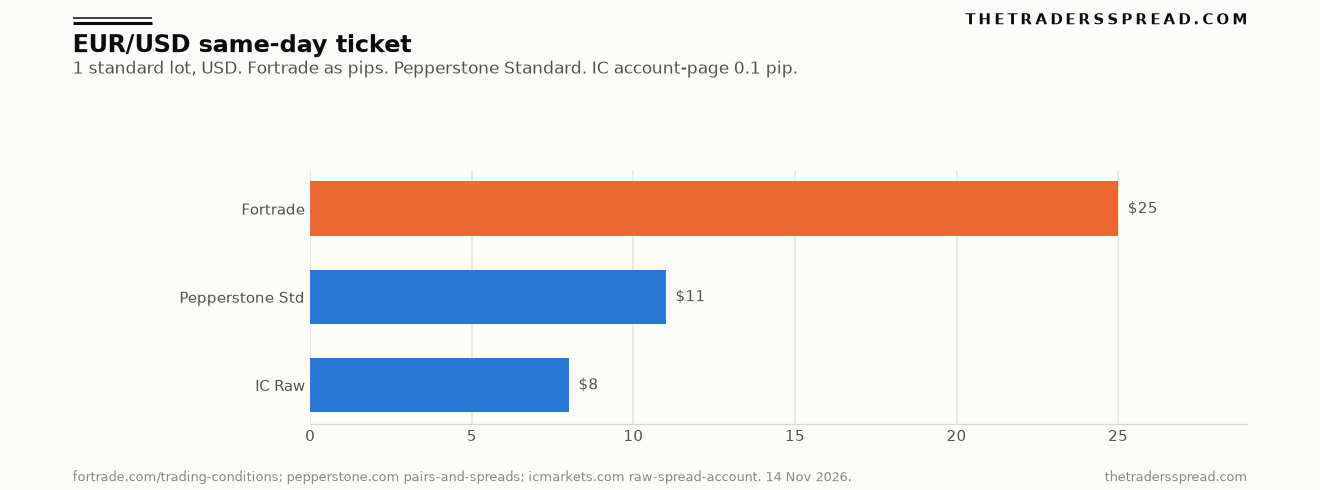
| Line on one standard lot | Fortrade | Pepperstone Standard | IC Raw, account page |
|---|---|---|---|
| Spread used | 2.5, read as pips | 1.1 pips average | 0.1 pips average |
| Spread in dollars | 25 | 11 | 1 |
| Commission, round turn | 0, from the homepage line | 0 | 7 |
| Same-day total | 25 | 11 | 8 |
Fortrade and Pepperstone Standard are spread-only tickets, so the visible cost moves when the spread moves. IC's Raw ticket is mostly commission, 7 dollars of it, beside 1 dollar of spread at the stated average, whether that minute prints 0.0 or 0.3. A quiet morning can change the Fortrade line by much more, because almost all of its published cost sits in a spread that can widen at night.
Other euro-dollar tickets on this desk sit at the broker comparison hub, including an IG Group euro-dollar ticket whose fee stack is built differently. Those pages are further reading only. The peer figures above come from Pepperstone's pages and from IC's pages opened on 14 November 2026.
Which company the card belongs to
Fortrade is a brand used by several licensed firms. The risk-warning link retrieved on 14 November 2026 points at a Mauritius PDF naming Fortrade Mauritius Ltd, authorised by the Financial Services Commission, Mauritius, under SEC-2.1B investment dealer number GB21026472, at The Cyberati Lounge, Ground Floor, The Catalyst, Silicon Avenue, 40 Cybercity, 72201 Ebene. The homepage prints that Mauritius licence line beside a London number, +44 20 4571 7564. A London dialling code is a contact detail, and a weak substitute for the name on the account contract.
Related12 Points on NordFX Pro EUR/USD, Counted in Dollars
The same footer also names Fortrade Ltd, 93 Gloucester Place, London, W1U 6JQ, FCA 609970, with an office at Michelin House, 81 Fulham Road, and Fortrade Cyprus Ltd under CySEC CIF 385/20, plus Canada, Australia, DIFC, and FT Securities Malta Ltd under the MFSA. UK and EU retail CFD rules cap major-pair leverage at 1:30. This row shows 1:200 and 0.5 percent, an offshore ratio and a poor match for the FCA firm or the CySEC firm.
Open the account agreement and read the company name in the first definition. If the name is Fortrade Mauritius Ltd, the card retrieved on 14 November 2026 is the public schedule that matches this row. If the name is Fortrade Ltd or Fortrade Cyprus Ltd, ask that firm for its own currency table before treating 2.5, or 1:200, as the live condition. One website introduces several books, and the ticket is held by one of them.
Pros, cons, and a verdict
The public card shows the average, the margin, the leverage, the unit size, the hours, the daily rates, the Wednesday triple rollover, and a dormancy fee with a number attached. The homepage states zero commission and adds that other fees apply. Negative-balance protection appears on the trading-conditions disclaimer and again on the Mauritius risk file, where a retail client can lose the account balance and the firm describes a stop at that balance.
The weaknesses sit beside those prints. An average of 2.5, read as pips, is more than twice Pepperstone Standard and stays above the IC account-page ticket after the 7 dollar commission. The EUR/USD night width is blank on a card that prints one for GBP/USD and USD/JPY, and the spread column omits the unit. Several legal entities share the footer. A raw spread with a stated commission means leaving the brand.
The card is usable as a public reference. Under the pip reading the same-day bill is 25 dollars, against 11 dollars on Pepperstone Standard and 8 dollars on the IC account-page ticket, and IC's spreads table still prints a different raw average. The rating is 3.2 out of 5, with points off for the wide average, the blank night width, and the multi-entity footer, and points kept for a card on the open web.
Questions readers ask about this ticket
Is the 2.5 figure a pip or a point?
A pip on EUR/USD is 0.0001, worth 10 dollars on the card's 100,000-unit lot, and a point on a five-decimal quote is 0.00001, worth 1 dollar on that lot. The average-spread cell prints 2.5 with no unit word. The working reading takes 2.5 as pips because the same column prints 800 on EUR/TRY and 250 on EUR/ZAR. A point reading would shrink the bill from 25 dollars to 2.50 dollars, so the live ticket still has to confirm the unit.
Which Fortrade company is this card for?
The trading-conditions page opened on 14 November 2026 links its risk warning to Fortrade Mauritius Ltd, FSC number GB21026472. The same footer also names Fortrade Ltd under FCA 609970, Fortrade Cyprus Ltd under CySEC 385/20, and other group firms. The EUR/USD row shows leverage of 1:200 and margin of 0.5 percent, an offshore ratio beside the 1:30 retail cap on UK and EU CFD books. The company name in the account agreement decides which schedule applies.
What sits on the same-day bill, and what waits?
A same-day round turn is the open plus the close. The spread is crossed once, and a per-side commission is counted twice. Fortrade's homepage prints zero commission and adds that other fees apply, so the spread is the explicit ticket when the position closes the same day. The daily rate, the Wednesday triple rollover, and dormancy of 10 dollars, euros, or pounds a month after six inactive months sit outside that bill.
Checklist before relying on the quoted cost
The 25 dollar figure is a reading of a public average, retrieved 14 November 2026, under a pip interpretation and a zero-commission homepage line. Before that number is treated as the cost of a live EUR/USD ticket, check the card and the contract on these points.
- Match the company name on the account agreement to Fortrade Mauritius Ltd, or to another firm in the footer, before using 2.5 or 1:200 from this row.
- Read the average-spread cell again and see whether the live ticket states pips, points, or a dollar width, because the public header is silent.
- Read the EUR/USD night-spread cell, empty on 14 November 2026, while (*6) still named 20:55 to 06:00 GMT and GBP/USD printed a night width of 8.
- Set the account's commission line beside the homepage sentences "Zero Commission" and "Other fees apply."
- If the position might still be open at the close, read both daily rates, the 100-unit example footnote, and the Wednesday triple-rollover bullet.
- If the account might sit for six months, read the dormancy line of 10 dollars, 10 euros, or 10 pounds a month.
- If the comparison drives the choice, re-open Pepperstone's pairs page and IC's Raw Spread page, because 1.1 is an August 2026 window and IC's table prints 0.01 against the account page's 0.1.
CFDs are complex instruments and can lose money rapidly because of leverage. This review is journalism based on public pages opened on 14 November 2026. It is not a recommendation to open an account or to place a trade. Published averages move, and the spread on the live ticket can differ from the figure printed on the card.