
I opened an IG Group euro-dollar ticket the way this desk opens any broker file: the legal name first, the contract size second, and only the charges that firm still prints on its own pages. The contract I counted is one standard EUR/USD cash CFD with IG Markets Ltd, on the IG web platform, at the retail margin the product page prints. At the minimum spread of 0.6 points, and at the $10 point value on that standard contract, the opening markdown is $6. The same product page still carries an average spread from a window that ends on 8 January 2021, so the average stays a dated label and the minimum is the schedule a client can read on the charges page today.
Updated 13 November 2026, from the IG, FCA, Companies House, Pepperstone, and OANDA pages named below.
IG Group is the group name on the door. A UK CFD is a contract with one of the companies that trade as IG, and the charges footer says which company provides which product. I kept this count on the CFD book. A spread bet with the sister company can show the same 0.6 point minimum and still be a different contract, with a different firm reference number.
Which figures sit on the ticket before any overnight charge?
- The counted ticket is one standard EUR/USD cash CFD at IG Markets Ltd, retail margin 3.33%, quoted as a spread on the IG web platform. Source: IG forex CFD product details and the IG UK charges page, retrieved 13 November 2026.
- The minimum spread is 0.6 points and one standard contract is worth $10 a point, so the floor on that contract is $6. Source: IG forex CFD product details and the IG UK charges page, retrieved 13 November 2026.
- IG Markets Limited, company 04008957, firm reference number 195355, shows the status Authorised, with authorisation dated 1 December 2001, at 88 Wood Street, London, EC2V 7DA. Source: FCA Firm Checker, retrieved 13 November 2026.
- The product page still prints an average EUR/USD spread of 0.85 points from 00:00 to 21:00, and 1.04 points across the fuller week, for the 12 weeks ending 8 January 2021. Source: IG forex CFD product details, retrieved 13 November 2026.
- The CFD tab prints an FX overnight admin fee of 1%. The overnight help page, dated 8 September 2026, puts 0.3% inside the standard-contract formula, and the product notes cap the IG portion at 0.0022% a day. Source: IG UK charges, the overnight funding page, and the forex CFD product details, retrieved 13 November 2026.
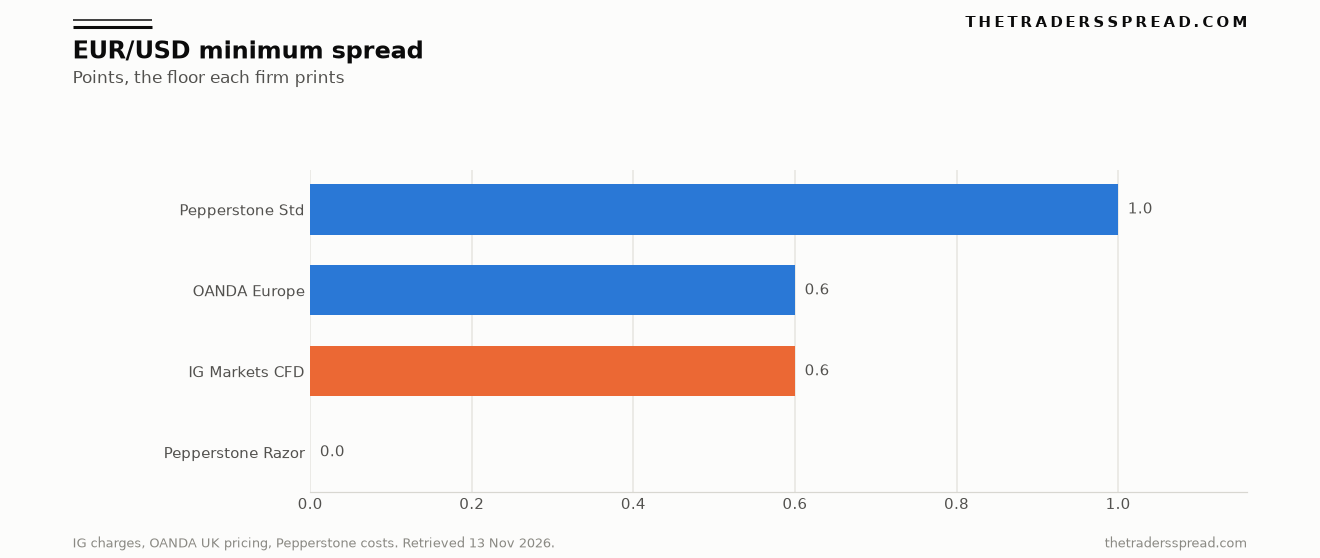
- Pepperstone Markets Limited prints a Standard EUR/USD minimum of 1.0 point and a Razor minimum of 0.0, with Razor FX commission from $3.50 per lot per side. OANDA Europe Limited prints EUR/USD spreads from 0.6 pips. Source: Pepperstone costs and pairs pages, and OANDA's UK pricing page, retrieved 13 November 2026.
Which company actually holds an IG Group euro-dollar CFD?
The footer on the IG UK charges page, opened on 13 November 2026, splits the trading name into English companies at one London address. Share dealing and IG Smart Portfolio accounts are provided by IG Trading and Investments Ltd. CFD accounts are provided by IG Markets Ltd, company 04008957, FCA register number 195355. Spread betting is provided by IG Index Ltd, register number 114059. Cryptoasset services are named with IG Digital Assets Ltd. The sentence that matters for this ticket is the CFD one: the counterparty on a UK CFD account is IG Markets Ltd.
I then opened the FCA Firm Checker for firm 195355. The page is headed IG Markets Limited. It shows ig.com, the phone number +44 20 7896 0011, authorisation since 1 December 2001, firm reference number 195355, and registered company number 04008957. The status line on that checker reads Authorised, and the address block reads 88 Wood Street, London, EC2V 7DA, United Kingdom. The page says the firm has confirmed that its contact details are correct, which firms must do at least once a year, and it tells the reader to confirm the exact product with the firm.
Companies House for 04008957, opened the same day, shows IG MARKETS LIMITED as an active private limited company, incorporated on 1 June 2000, registered office 88 Wood Street, London, EC2V 7DA, SIC 66120, with accounts to 31 December 2025. The charges footer prints that same street as EC2V 7QR, so a letterhead and the register disagree on the postcode as of 13 November 2026.
The Firm Checker also carries a clone notice. The wording says this is a genuine firm, that scammers have copied its details, and that a reader should use the registered phone number on that page, +44 20 7896 0011.
The regulator's own account is still publishing a weekly tally of warnings about unauthorised firms and clones.
In the past 7 days we issued 15 warnings about unauthorised or clone firms.
— Financial Conduct Authority (@TheFCA) November 6, 2026
Protect yourself and find all recent warnings https://t.co/F6gjRRqNx5#FCAWarnings #FinancialRegulation pic.twitter.com/j99SRzs7po
Register number 114059, for IG Index Ltd, is the spread-bet book named in that same footer. The dollar ticket below is the CFD with IG Markets Ltd, and I left the IG Index Firm Checker outside this count.
Which contract, platform, and client tier did this desk count?
IG's forex CFD product details, a help page dated 8 September 2026, say every pair comes in two sizes. A standard contract is 100,000 of the first-named currency. A mini contract is 10,000 of the first-named currency. For EUR/USD the value of one point is $10 on the standard contract and $1 on the mini. The notes set the minimum transaction at one contract and allow fractions above that minimum, scaling the dollar value with the fraction. I counted one standard contract, because that row publishes a dollar value per point.
The EUR/USD row prints a retail margin requirement of 3.33%. Note 5 says margin is a percentage of overall position value, that tiered margins live in the platform's market information, and that a larger position can require a higher margin. I am leaving the posted margin as that percentage rather than pinning a sterling amount to a quote that will have moved by the time a reader deals. The platform on this ticket is the IG web platform, listed on the charges page beside mobile, TradingView, MetaTrader 4, and ProRealTime. The CFD tab says the forex spread is built into the price shown when the client submits the trade, so the dealing ticket is the bid, the offer, and the gap between them. The tier is a retail client on the standard cash CFD, and a professional account, a mini, a forward, and the weekend market stay off the $6 figure.
The product notes call these foreign-exchange trades a special form of cash-settled CFD: exposure to the exchange rate, with delivery of the underlying euros or dollars outside the contract. Ordinary dealing hours run from 21:00 London time on Sunday until 21:59 London time on Friday, and the notes warn that daylight-saving shifts can move the printed clock. The weekend EUR/USD row is a separate market.
What does the opening spread cost at the printed minimum?
On the CFD tab, EUR/USD shows a minimum spread of 0.6 points, and the spread-betting tab prints the same 0.6. Spreads vary with the underlying market and sit inside the price on the ticket. Beside that block the CFD tab shows EUR/GBP at 0.9, GBP/USD at 0.9, and USD/JPY at 0.7, so EUR/USD is the tightest minimum of the four. The product row matches: standard contract, minimum 0.6, value per point $10. Six tenths of a point times ten dollars is six dollars. A round turn that opens and closes while the quote is still 0.6 points wide crosses that gap once and also costs $6, and a wider live quote costs the wider gap times $10.
Forex on the CFD tab is priced in the spread. Commission on that tab is for share CFDs, at 0.10% for UK shares, 0.10% for euro shares, and 2 cents a share for US shares. Note 9 says that where an FX commission is charged, any further commission follows written notice. The guaranteed-stop premium on the EUR/USD standard row is 1.2 points, $12 at the standard point value, charged if that stop is triggered, and the notes say the premium can change into weekends and in volatile conditions. A sterling account can also meet the 0.8% conversion fee the CFD tab prints when the trade currency differs from the account base. That rate applies to the cash converted, and it stays off the $6 spread.
Weekend EUR/USD is a separate row, with the same $10 point value, a minimum spread of 6, and retail margin of 3.33%. Six points times $10 is $60 at that floor, ten times the weekday minimum. Bank transfers, debit cards, and credit cards are marked free, with a £99,999 debit-card cap and a £30,000 credit-card cap per transaction. Opening, closing, maintenance, and the inactivity fee are marked free.
Why is the average spread on the product page a stale label?
Under the majors table, the forex CFD product page defines two averages and dates both of them to the 12 weeks ending 8 January 2021. The single asterisk runs Monday 00:00 to Friday 22:00 GMT. The double asterisk runs 00:00 to 21:00 GMT, Monday to Friday. On EUR/USD those cells read 0.85 for the daytime window and 1.04 for the fuller week. The minimum, 0.6, is the figure that also appears on the charges page opened in November 2026, while the help-page header still reads 8 September 2026. The counted ticket stays with that minimum: 0.6 points, $6 on one standard contract, widening when the market widens.
Quotations come from banks and liquidity providers. IG says it offers the minimum spread when the market spread is particularly small, that a typical spread applies in most other conditions, and that a wider underlying market can be matched. A replacement average, with an end date after January 2021, is still unpublished on that page.
What gets added if the position is still open at 10pm?
The opening spread is a one-time gap. A position still open past 10pm UK time picks up a funding adjustment, and the pages I opened on 13 November 2026 split that charge into interest on the relevant interbank rate plus an admin fee. On the CFD tab the FX admin fee is 1% and other asset classes are 3%. On the spread-betting tab FX is 1.5% and other asset classes are 3.4%.
The overnight funding help page, dated 8 September 2026, says forex and spot-metals deals take the tom-next rate plus an admin fee of 1.5%. Further down, the CFD base calculation uses another percentage. Step one is the price in points, times 0.3%, or 0.8% for mini contracts, divided by 360. Step two adjusts tom-next: a short position takes that value off the tom-next, and a long position adds it. Step three multiplies contracts by contract value by that swap rate. The spread-bet version of step one uses 1.5%, so the charges tab, the introductory sentence, and the standard formula print 1%, 1.5%, and 0.3%.
IG's worked CFD example uses its own inputs. It is a short position of one EUR/USD standard lot, contract value $10, tom-next 0.34 bid and 0.39 offer, closing spot 1.0650. Value equals 10,650 times 0.3% divided by 360, which the page gives as 0.08875. The swap rate is 0.34 minus 0.08875, rounded to 0.25, and the cost is one contract times $10 times 0.25, a $2.50 credit. Those inputs, including the spot of 1.0650, are a sample still printed on the page. A shorter example says the client is long one EUR/USD contract at $10, then names the GBP/USD swap offer at minus 0.85 and multiplies through to an $8.50 debit, so the heading and the pair label disagree.
The product-details notes post funding daily as A = V × R, where V is contracts times contract size and R is the current tom-next including the IG charge, capped at 0.0022% a day, with a cutoff of 22:00 London time. In November, with the UK on GMT, that cutoff and 10pm UK time are the same hour. Multiplying 0.0022% by the 360-day divisor comes to 0.792%, near the 0.8% mini-contract input and away from the 1% on the CFD charges tab. The live tom-next for 13 November 2026 stays on the platform. Through Wednesday 10pm UK time the FX adjustment covers three days, because spot FX settles on a T+2 basis, while a Friday hold is one day.
How do Pepperstone and OANDA print the same pair?
I pulled two outside schedules from each firm's own pages on 13 November 2026. The chart is the minimum EUR/USD spread each page prints, in points. Commission stays off the bars, because the Razor floor is zero and the commission is the line that gives that zero its meaning.
RelatedHow Does TradeStation Price One EUR/USD Forex Ticket?
The Pepperstone costs page and the pairs and spreads page name Pepperstone Markets Limited, company registration 177174 B, at 1 Pineapple House, Old Fort Bay, Nassau, licensed by the Securities Commission of The Bahamas under SIA-F217. The risk warning says 80% of retail investor accounts lose money when trading CFDs with this provider. Under the SCB permission on the costs page, retail FX exposure runs up to 1:200, beside IG Markets Limited's FCA retail margin of 3.33% on this pair.
On the costs page, EUR/USD shows a Razor minimum of 0 and a Standard minimum of 1. The pairs page adds averages for 1 August 2026 through 31 August 2026, all sessions including rollover: Razor average 0.1, Standard average 1.1. Standard forex is priced inside the spread, with the FX commission reserved for other account types. A Razor account pays commissions from $3.50 per lot per side on FX and on spot gold. Deals below one lot scale that commission, a non-dollar account converts the $3.50 at the spot rate, and at that $3.50 floor on one lot the round turn is $7.00. The pages I opened leave a EUR/USD point value unstated, which is why the Pepperstone bars stay in points.
OANDA's UK pricing page says spreads start from 0.6 pips on EUR/USD, beside 1 point on the UK 100, 1.2 points on Germany 40, and 1.3 pips on USD/JPY. The UK instruments page footer names OANDA Europe Limited, company 7110087, Dashwood House, 69 Old Broad Street, London EC2M 1QS, authorised and regulated by the Financial Conduct Authority, number 542574. The pricing page's risk warning says 76.6% of retail investor accounts lose money when trading CFDs with this provider. The 542574 figure is from OANDA's footer. A separate Firm Checker page for OANDA stayed outside this session, and a separate per-lot EUR/USD commission is absent from the pricing page. OANDA describes the 0.6 pip figure as a minimum, with prices drawn from liquidity providers.
As floors, IG Markets and OANDA Europe sit together at 0.6 points, Pepperstone Standard sits at 1.0, and Pepperstone Razor sits at 0.0 until the commission is added back. The IG ticket is the one I can finish in dollars from the firm's own contract size, $6 at the minimum on one standard CFD. The same counting habit is already on the brokers desk, including the Plus500 ticket, the FXCM UK tier, and the Markets.com contract holder, and the bars above use the IG, Pepperstone, and OANDA pages opened on 13 November 2026.
Where is the paperwork clean, and where does the count break?
The clean part is the identity of the CFD and the price of getting in at the floor. IG Markets Limited is on the FCA register as Authorised, company 04008957 matches Companies House, and the charges footer says that company provides the CFD account. One standard contract, while the screen shows 0.6 points, is six dollars of spread, and card funding plus the inactivity fee are marked free.
The break is the January 2021 average still sitting under an 8 September 2026 header, the three admin inputs of 1%, 0.3%, and 0.0022% a day, the help-page example that heads a EUR/USD long and then plugs in a GBP/USD rate, and the postcode split between EC2V 7DA on the register and EC2V 7QR on the charges footer. The weekend minimum of 6 points is $60, and a guaranteed stop that fires adds $12.
Each firm prints its own retail-loss line beside those breaks: 70% on the IG charges page, 80% on Pepperstone's Bahamas pages, and 76.6% on OANDA's UK pricing page. The spread-bet tab prints the same 0.6 point EUR/USD minimum and a 1.5% FX admin fee, and the footer places that product with IG Index Ltd. I counted IG Markets Ltd because that is the CFD provider, and a spread bet sized in pounds per point stays off this dollar count.
What did the counted ticket come to?
The ticket I counted is one standard EUR/USD cash CFD with IG Markets Ltd, retail, on the IG web platform: 0.6 points minimum, $10 a point, $6 to cross that minimum once. A wider screen costs the wider gap times $10. A hold through 10pm UK time costs the platform swap, and the public pages still describe the admin percentage inside that swap in three different ways. I score the paperwork 3.8 out of 5, because the firm, the contract, and the opening floor are countable, while the average and the overnight admin are documents that still argue with each other.
Spread bets and CFDs are complex instruments and can lose money rapidly because of margin. IG states that 70% of retail investor accounts lose money when trading spread bets and CFDs with this provider. This review records schedules retrieved on 13 November 2026, and the decision to open, hold, or close a position stays with the reader.