
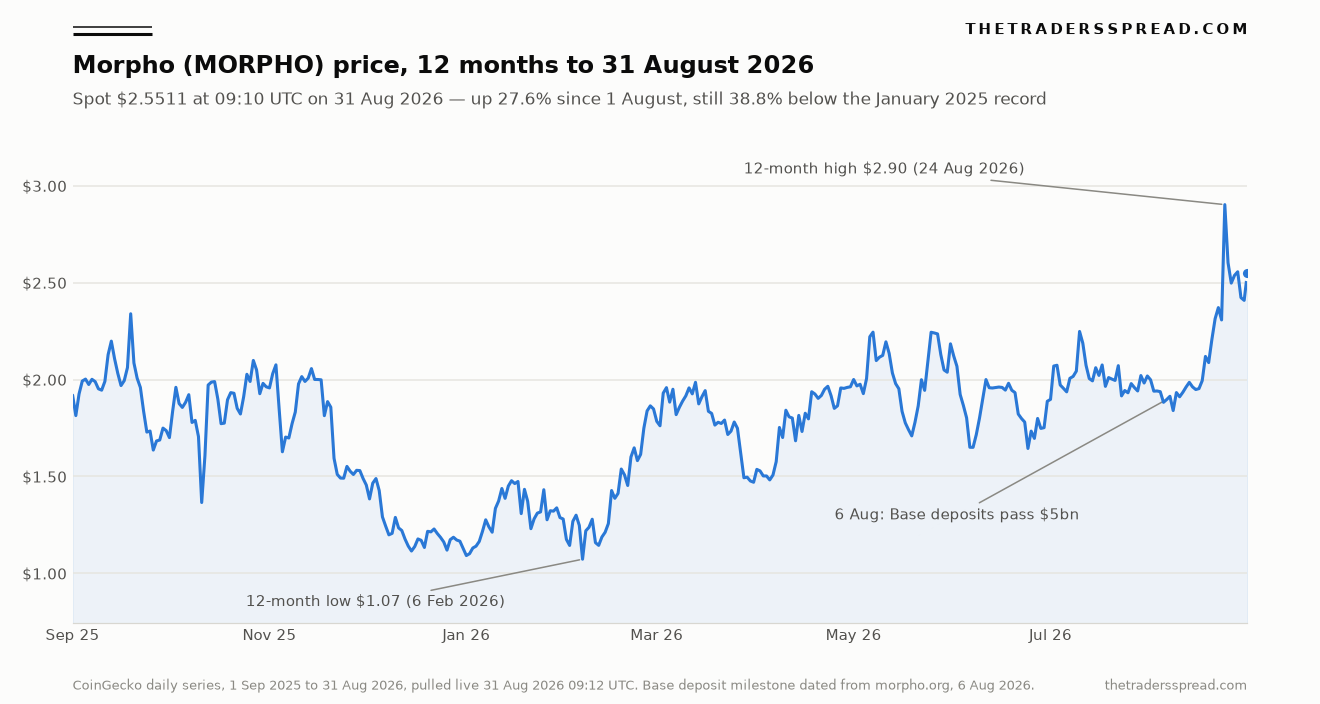
Morpho (MORPHO) did not rally in August because a lending token finally caught a bid. That is the lazy read, and the data refuses it: Aave's total value locked rose 25.4% over the same month, almost to the decimal, while the AAVE token remains 61.4% lower over a year. Morpho's move is not sector beta wearing a new logo. It is the market slowly repricing a protocol that has spent twelve months quietly converting itself from an Ethereum lending venue into the credit backend of Base, and from there into the plumbing behind Coinbase, Robinhood, Kraken and Uniswap. MORPHO changed hands at $2.5511 at 09:10 UTC on 31 August 2026, up 27.6% from $1.9989 on 1 August, according to CoinGecko. The headline that moved it was published on 6 August: Morpho's deposits on Base had passed $5bn.
Here is the thing almost nobody has said out loud. Pull DefiLlama's per-chain series for Morpho Blue and the growth story collapses into a single geography. Morpho's total TVL rose from $7.2391bn on 31 August 2025 to $9.5142bn on 31 August 2026, a gain of $2.2751bn. Of that, Base contributed $2.2060bn, moving from $1.6866bn to $3.8926bn. That is 97.0% of the entire year's growth from one chain. Morpho's Ethereum deposits over the same twelve months went from $4.3247bn to $4.3151bn, which is to say nowhere at all. The protocol did not grow. Its Base deployment grew, and everything else stood still. That is a concentration story dressed as an expansion story, and it changes what a MORPHO holder is actually exposed to.
Key facts
- MORPHO spot $2.5511, market capitalisation $1.677bn, rank 51, 24-hour volume $32.3m — CoinGecko, pulled 09:10 UTC, 31 August 2026.
- Price up 27.6% from $1.9989 on 1 August to $2.5511 on 31 August; but down 7.7% over the past seven days and 12.1% below the 24 August 12-month high of $2.9026 — CoinGecko, 31 August 2026.
- Morpho Blue TVL $9.5142bn on 31 August 2026, up 25.4% from $7.5872bn on 1 August and up 31.4% from $7.2391bn a year earlier — DefiLlama, 31 August 2026.
- Base accounts for $3.8926bn of that, or 40.9% of protocol TVL, and 70.8% of the entire Base chain's $5.4989bn in DeFi TVL — DefiLlama, 31 August 2026.
- Morpho's own count of Base deposits passed $5bn, "contributing to more than 70% of all deposits on the network" — morpho.org, 6 August 2026.
- Morpho Blue generated $208.77m in fees over the trailing year and $17.79m in the past 30 days, of which $0 accrued to the protocol — DefiLlama fees API, 31 August 2026.
- Aave's TVL sits at $17.8889bn, still 60.9% below its $45.8089bn peak of 7 October 2025 — DefiLlama, 31 August 2026.
What actually happened, and the mechanism underneath it
On 6 August 2026 Morpho published a post titled "$5B On Base Is The New Day One For Onchain Finance". The claim was specific: total deposits on Base had crossed $5bn, representing more than 70% of all deposits on that network. Morpho deployed on Base in May 2024, when the chain held $1.8bn in total deposits. By the company's own count that figure now sits at $6.8bn.
The mechanism is what Morpho calls the DeFi Mullet, and it explains why the deposits are sticky. A regulated consumer platform owns the front end and the customer relationship. Morpho owns the credit engine at the back. Neither side has to build the other. Coinbase launched crypto-backed loans on this architecture in January 2025 and completed the rollout in May 2025. That single product now carries over $1.3bn in outstanding USDC borrowing against $2.5bn of cbBTC collateral, and Coinbase-originated borrowing alone accounts for roughly 26% of all Morpho deposits on Base.
The collateral concentration is more extreme than the deposit concentration. Morpho reports that roughly 39% of all cbBTC across every chain is deposited on Morpho, and 82% of all cbBTC sitting on Base. That is not a lending protocol competing for flow. It is one that has become the default destination for a specific tokenised asset, the way a single custodian can end up holding most of a market's collateral without anyone deciding it should. Our note on MicroStrategy's bitcoin stack trading near its cost basis covers the equity-side version of the same collateral question.
Stablecoins do the rest. Morpho names Circle's USDC and Ethena's USDe as the leading issuers behind Base's record stablecoin deposits, and real-world asset issuers including Centrifuge, Midas, Spiko and Birch Hill are now running the same playbook. Morpho puts its RWA deposits above $1.3bn.
"Decentralized finance technology works best as infrastructure, allowing brands and institutions to offer products that are more open, more transparent and more competitive than those built on traditional financial rails," said Paul Frambot, Co-founder of Morpho, in the 1 July 2026 announcement of the Robinhood integration.
Who is actually plugged in
The integrator list is the part of this story that is hardest to argue with, because each name carries its own compliance department and its own reason to have said no.
Robinhood Earn went live in July 2026, using USDG as the deposit asset, Steakhouse Financial as vault curator and Robinhood Chain as the settlement layer. Morpho says the product crossed $100m of deposits within two weeks and stood above $250m by early August. DefiLlama's independent series backs the trajectory: Morpho's TVL on Robinhood Chain first registered on 3 July 2026 at $10.7m and reached $490.7m by 31 August 2026. That is a standing start to nearly half a billion dollars in under two months, on a chain that did not exist publicly before the summer.
"By leveraging Morpho's open credit network alongside USDG and Robinhood Chain, we are giving our eligible users the ability to seamlessly access the competitive advantages of decentralized finance," said Gaëtan Thabot, Director of Partnerships at Robinhood Crypto, in the same announcement.
Uniswap Labs launched Uniswap Earn on Morpho in July. Kraken's DeFi Earn product now allocates more than $400m of deposits to Morpho, of which over $300m is bitcoin. Deblock, the French neobank, has passed $100m in Morpho-powered earn deposits. Hashkey Group, which operates a licensed digital-asset exchange in Hong Kong, has signed a strategic partnership. Galaxy has launched its own curator on top of Morpho and routes institutional borrowers through it.
The capital behind the network is similarly institutional. Morpho Association raised $175m on 9 June 2026, co-led by Paradigm, a16z crypto and Ribbit, with participation from Apollo Funds, Circle Ventures, VanEck and Ledger Cathay. "Morpho's vision of traditional finance using blockchain networks to become more efficient and effective is becoming a reality before our eyes," said Guy Wuollet, General Partner at a16z crypto, in the funding announcement. Gabe Mennesson, Partner at Ribbit Capital, framed the target market in the same release: "Lending is the largest profit pool in financial services, yet much of its infrastructure remains fragmented, opaque, and inefficient."
Not every venue where Morpho has deployed is pulling its weight. DefiLlama shows $320.1m on Hyperliquid L1 and $180.6m on Monad against $3.8926bn on Base, which is to say the multi-chain footprint of 42 networks is, in practice, two networks and a long tail. Hyperliquid's own token has run harder than MORPHO this year, as our piece on Hyperliquid's 52% climb on the CFTC onshoring push sets out, but its lending stack is not where the deposits went.
The market data, and one number that does not reconcile
Two independent sources describe the same protocol and disagree by roughly half. On 6 August 2026 Morpho reported more than $5bn of deposits on Base. DefiLlama's Base series for Morpho Blue put the figure at $3.2513bn on that date. In the June funding release Morpho cited "$11B+ in deposits" across the network; DefiLlama had Morpho Blue at $6.5178bn on 9 June 2026.
These are not competing truths so much as different accounting. A deposit routed into a Morpho vault and then allocated by that vault into a Morpho market can legitimately be counted twice by a gross deposit metric and once by a de-duplicated TVL metric, and Morpho's headline figure also spans deployments that DefiLlama tracks under separate adapters. What matters for a reader is the ratio rather than the level, and the ratio survives the disagreement. DefiLlama independently puts Base's whole-chain DeFi TVL at $5.4989bn and Morpho Blue's Base deposits at $3.8926bn, which is 70.8%. Morpho's own claim of "more than 70% of all deposits on the network" is therefore corroborated by a source that reaches a very different absolute number.
Where the two agree is on trajectory, and that is where the calibration matters.
| Metric, 31 August 2026 | Morpho | Aave |
|---|---|---|
| Protocol TVL | $9.5142bn | $17.8889bn |
| TVL change, 1–31 August 2026 | +25.4% | +25.4% |
| TVL change, year on year | +31.4% | −54.5% |
| Distance from record TVL | at or near record | −60.9% from 7 Oct 2025 |
| Token market capitalisation | $1.677bn | $1.914bn |
| Token price change, year on year | +28.0% | −61.4% |
| Market cap divided by TVL | 0.176x | 0.107x |
Sources: DefiLlama protocol and chain series and CoinGecko markets endpoint, both pulled 31 August 2026.
Read the first two rows together and the August move looks like nothing special. Morpho's TVL rose 25.4% in August; Aave's rose 25.4%. Whatever drove August — stablecoin supply, a broad risk bid, the alt complex generally — drove both. Anyone attributing the whole of MORPHO's 27.6% month to the Base announcement is fitting a story to a number.
Read the next three rows and the picture inverts. Over a year Morpho's deposits grew 31.4% while Aave's fell 54.5%. Morpho's market capitalisation is now 87.5% of Aave's on 53.2% of Aave's TVL. The equity market, such as it is, has already paid up for the share shift: Morpho trades at 0.176 times its TVL against Aave's 0.107 times. That is a 64% valuation premium per dollar of deposits, and it is the single clearest argument that the re-rating is not still ahead of the market.
The wider cohort supports the direction without supporting the hype. Across a live CoinGecko screen of fourteen large DeFi and layer-one tokens on 31 August 2026, only three were positive over twelve months: Hyperliquid at +82.5%, Morpho at +28.0% and Sky at +6.3%. Aave sat at −61.4%, Compound at −56.0%, Pendle at −63.7% and Ethena at −77.8%. Morpho is the best-performing pure lending token in that basket by a wide margin, which is a real distinction, but it is not the only survivor. Our coverage of Ethena (ENA) and of Solana's ETF-driven move covers two other legs of that screen.
One caution the 30-day headline hides: MORPHO is down 7.7% over the past seven days and sits 12.1% below its 24 August high of $2.9026. The August gain is real and the last week of it has already been given back in part.
The regulatory question nobody in the announcement addressed
Morpho's policy team spent the week of 20 July 2026 in Washington, meeting the SEC Crypto Task Force, the CFTC Innovation Task Force, the Department of the Treasury and Senate offices. Morpho's own newsletter described the week as "an encouraging step toward regulatory clarity for onchain finance". The document it pointed to reads rather differently.
On 22 July 2026 SEC Commissioner Hester M. Peirce published "Headstands and Summervaults: A Statement on Crypto Vaults and Lending Strategies". It opens with a warning, not a clearance. "If you do headstands, backflips, and other gymnastics to read the law so that it does not apply to crypto assets and activities that are well within the scope of the federal securities laws, you will have a painful fall," Peirce wrote.
The specifics land squarely on the curator model that Morpho's institutional business depends on. Peirce identified vaults as spanning a spectrum "from programmatic allocations determined solely by immutable smart contracts, to allocations at the sole discretion of another person or group of persons", and noted that parties managing them — "by selecting the yield-generating activities, re-allocating assets among yield-generating assets, or selecting the parties that will make those decisions" — may need to analyse whether their activities implicate the securities laws. On lending specifically she listed "setting interest rates, deciding which assets to accommodate, setting loan-to-value limits, and establishing liquidation thresholds". She cited United Housing Foundation v. Forman on common enterprise and Reves v. Ernst & Young on when a note is a security.
Morpho Blue itself is immutable and permissionless, which places the base layer at the friendly end of that spectrum. The curators do not sit there. Steakhouse Financial sets the parameters behind Robinhood Earn. Galaxy runs its own curator. The exposure, if it crystallises, attaches to the layer that makes discretionary allocation decisions on behalf of retail depositors reached through a broker-dealer's app.
RelatedHedera (HBAR) Price Prediction: $0.115 Bull vs $0.052 Bear
There is a second structural tension in the numbers. Morpho Blue produced $208.77m of fees over the trailing year and $17.79m in the past 30 days, and DefiLlama records protocol revenue of exactly zero across every window. Every dollar of that flows to lenders and curators; none accrues to the protocol or, by extension, to the token. A MORPHO holder today owns governance over a network that has never switched on a take rate.
What this changes
The first consequence is that Morpho's risk profile is now largely Base's risk profile. When 97.0% of a year's deposit growth arrives on one chain and that chain's own DeFi TVL is 70.8% Morpho, the two are no longer independent. A sequencer incident, a bridge problem or a governance dispute on Base is no longer a diversifiable event for Morpho; it is close to the whole exposure. The 42-chain footprint reads like diversification on a marketing page and does not behave like it in the data.
The second is that the fee switch has become the central governance question rather than a background one. $208.77m of annual fees with a zero take rate is a decision, not an accident, and it is reversible by governance. Any move to turn it on would change what the token is; any prolonged refusal to leaves a $1.677bn market capitalisation resting entirely on the option value of a future decision. Traders watching MORPHO should be watching the forum, not the chart.
The third is distribution risk running in the opposite direction to the usual worry. Morpho does not own its users. Coinbase, Robinhood, Kraken and Uniswap do. Roughly 26% of Base deposits originate from Coinbase alone. That relationship has been enormously productive, and it is also a single counterparty decision away from reversing. If Coinbase, which already operates Base, chose to route its credit products through infrastructure it controls outright, the re-rating argument would need rewriting from the first line.
What to watch through September: whether Robinhood Chain deposits keep the pace they set between July and August, or plateau near half a billion; whether Ethereum TVL finally moves off the flat line it has held for twelve months, which would turn a concentration story back into a growth story; whether Morpho Midnight, the fixed-rate, fixed-term product launched exclusively on Base, attracts institutional term lending or stays a small share of the book; and whether any curator responds publicly to the Peirce statement. Each of those is observable weekly on DefiLlama and in Morpho's own governance forum.
Frequently asked questions
How much has Morpho (MORPHO) actually risen?
MORPHO traded at $2.5511 at 09:10 UTC on 31 August 2026, against $1.9989 on 1 August, a gain of 27.6% across that window, per CoinGecko. Over twelve months the token is up 28.0% on CoinGecko's rolling one-year measure. It is also down 7.7% over the past week and sits 38.8% below its record high of $4.17 set on 17 January 2025.
What did Morpho announce about Base on 6 August 2026?
Morpho published a blog post stating that its total deposits on Base had passed $5bn, and that this represented more than 70% of all deposits on the Base network. The post dated the deployment to May 2024, when Base held $1.8bn in total deposits, and put the chain's current total at $6.8bn. DefiLlama's independent measure puts Morpho at 70.8% of Base's DeFi TVL.
Why do Morpho's deposit figures differ from DefiLlama's?
They measure different things. Morpho reports gross deposits, which can count a balance in a vault and again in the market that vault allocates to. DefiLlama reports de-duplicated TVL for the Morpho Blue adapter. On 6 August 2026 the gap was $5bn against $3.2513bn. The share of Base that Morpho represents is consistent across both sources at roughly 70%.
Does the Morpho protocol earn revenue from its lending markets?
Not currently. DefiLlama recorded $208.77m of fees generated by Morpho Blue over the trailing year to 31 August 2026 and $17.79m over the past 30 days, with protocol revenue of zero in every window. Fees accrue to lenders and to the curators who manage vault allocation. Switching on a protocol take rate would be a governance decision.
What did the SEC say about onchain vaults and lending?
On 22 July 2026 Commissioner Hester M. Peirce published a statement noting that vaults range from purely programmatic to fully discretionary, and that parties selecting yield strategies, reallocating assets, setting interest rates or establishing liquidation thresholds may need to assess whether their activities fall under the federal securities laws. She stressed that any conclusion turns on specific facts and circumstances.
How does Morpho compare with Aave right now?
DefiLlama puts Morpho Blue at $9.5142bn of TVL against Aave's $17.8889bn on 31 August 2026. Both grew 25.4% during August. Over twelve months Morpho added 31.4% while Aave shed 54.5%, and Aave remains 60.9% below its October 2025 peak. Morpho's token capitalisation is 87.5% of Aave's on 53.2% of the deposits.
Disclaimer
This article is analysis and information only. It is not financial advice, an offer, or a recommendation to transact in any asset. Digital assets are volatile and capital is at risk. Every price and protocol figure quoted was pulled live on 31 August 2026 from the named source and will move. Readers should conduct their own research and consider their own circumstances before making any decision.