
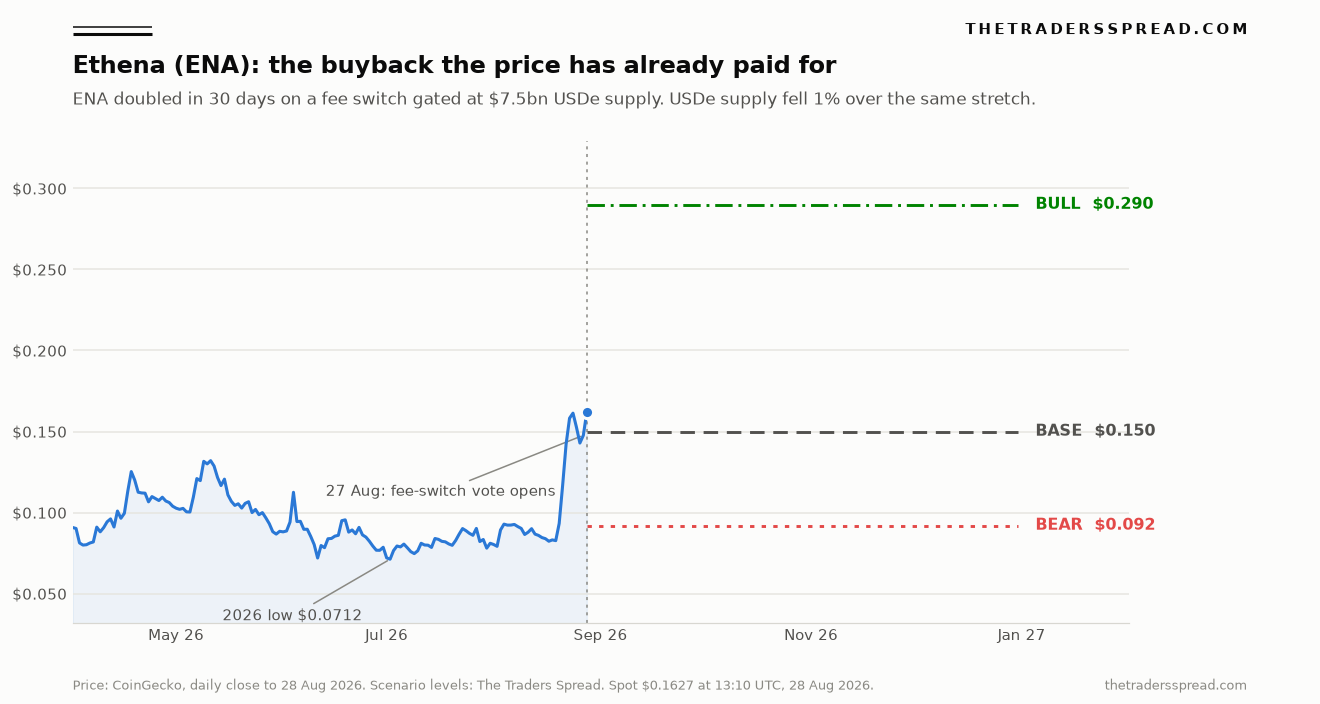
Ethena (ENA) has doubled in thirty days, and the catalyst everyone is citing is a buyback that cannot begin yet. Ethena is a protocol that issues USDe, a synthetic dollar which holds its peg by pairing spot crypto collateral against short perpetual futures instead of holding cash in a bank. On 27 August the Ethena Foundation opened a governance vote to route protocol revenue into ENA purchases. The token ran from $0.0827 on 19 August to $0.1627 by midday on 28 August.
Here is the part missing from the coverage. The buyback switches on only once USDe supply reaches $7.5bn. USDe supply is $4.043bn today. It was $4.082bn on 20 August, the session before the move began, which means the gating metric fell 1.0% while the token doubled. On the backtest run by a member of Ethena's own Risk Committee, the mechanism would have been live for 118 of the last 705 days at roughly a $52.7m annualised pace whenever it ran — an effective $8.8m a year. The market has added $786m of value in nine sessions. That is about 89 years of buybacks, priced before the gate has been crossed once.
Key facts
- ENA trades at $0.162701, up 100.8% in 30 days and down 75.2% over one year — CoinGecko, 13:10 UTC, 28 August 2026
- USDe circulating supply is $4.043bn, against a $14.820bn peak on 4 October 2025 — DefiLlama, 28 August 2026
- The first buyback tier requires USDe supply of $7.5bn, which is 85.5% above today's level — Blockworks Advisory breakdown via Bankless, 27 August 2026
- Ethena's gross fees have held near $17m a month all year: $16.70m in June, $17.51m in July, $17.17m in August to date — DefiLlama, 28 August 2026
- Protocol revenue over the same August window was $20,818, a take rate of 0.12% against 7.5% in August 2025 — DefiLlama, 28 August 2026
- 24-hour turnover is $2.138bn against a $1.599bn market capitalisation, a ratio of 1.34x — CoinGecko, 28 August 2026
- All remaining original investor tokens unlock at once from 5 October 2026, ending the monthly schedule — The Block, 27 August 2026
What the proposal actually does
The vote that opened on 27 August and runs to 2 September does two separate things, and conflating them is where most of the reporting has gone wrong. The first is a tiered fee switch: a share of Ethena's gross protocol revenue is routed to the Ethena Foundation, rising as USDe supply grows. The second is that 95% of whatever the Foundation collects is then spent buying ENA, with 5% funding growth.
The widely repeated figure of "95% of revenue to buybacks" is therefore 95% of a slice, not 95% of the whole. Per the breakdown published by Blockworks Advisory, that slice is 5% of gross revenue once USDe passes $7.5bn, 10% at $10bn and 15% at $15bn. The effective first-tier allocation is 5% multiplied by 95% — 4.75% of gross protocol revenue.
The mechanism is also conditional in a second way. Ethena has to keep sUSDe, its yield-bearing savings token, competitive against rival savings rates, because USDe supply is what generates the fees in the first place. If the yield falls behind, deposits leave, supply shrinks, and the fee base shrinks with it. The buyback is funded by the very thing it could undermine.
Whether that fee stream exists at all in a given week is decided by perpetual funding. When traders pay to be long, Ethena's short hedge collects, and the protocol earns; when funding flips negative, the position costs money to hold. Ethena has diversified into lending income and tokenised real-world assets to soften this, but the core engine remains a directional bet on crowd positioning being long.
That circularity is why the design has drawn scrutiny since long before this month's rally. Modelling the earlier version of the proposal in February 2026, Lilian Aliaga, who authored OAK Research's investigation into the fee switch, concluded that an "intermittent buyback can be more harmful to ENA token than no buyback at all". Readers following our crypto desk will recognise the pattern from other protocols that have tied token value to a revenue line they do not fully control.
Who is responding, and what they found
Ethena's Risk Committee is made up of Blockworks Advisory, LlamaRisk and Kairos Research, per the protocol's own documentation. That matters for how the most damaging number in this story should be read: it did not come from a critic on the outside. Reviewing the design on Ethena's governance forum, Blockworks found the trigger "would have been active just 118 of the last 705 days, buying ENA at roughly a $52.7M annualized pace whenever it was live".
Run that through: 118 of 705 days is 16.7% of the period. A $52.7m pace applied one day in six is an effective $8.8m a year. Against a $1.599bn market capitalisation that is 0.55% annually, and against $2.138bn of daily turnover it is roughly $24,000 a day, or 0.0011% of volume.
The same review supplies the strongest point for the other side, and it deserves equal weight. On the 93 days when sUSDe already out-yielded Sky's sUSDS, Blockworks found it stayed ahead even after the buyback took its cut on 82 of them. The fee diversion does not automatically break the deposit base, which is the objection that would have killed the proposal outright.
Separately, the Foundation bought out early backers holding locked tokens. Eligibility was limited to investors originally allocated more than 0.25% of supply who had sold at least one token since the market peaked on 10 October 2025. The Foundation stated that those "investors who have been selling into the market during the relevant time frame now hold no unvested ENA which could be sold into the market in the future". Neither the number of tokens nor the price paid was disclosed, as The Block reported.
The numbers behind the re-rating
Two things have moved in opposite directions this year, and the gap between them is the whole argument. Ethena's gross fee engine has been remarkably steady: $16.70m in June, $17.51m in July and $17.17m in the first 28 days of August, an annualised run rate near $224m. Its protocol revenue over that same August window was $20,818.
The take rate — the share of gross fees the protocol keeps rather than passing to sUSDe holders — has fallen from 7.5% in August 2025 to 0.12% in August 2026, a 99.5% collapse in absolute revenue. Ethena has been handing essentially the entire basis yield to depositors to defend a supply base that has fallen 66.9% year on year regardless.
Applying the tier-one rate to the current fee run rate gives an independent check on the Blockworks figure: 4.75% of $224m is about $10.6m a year. Two different methods, one from a governance backtest and one from the live fee series, land within 20% of each other. The buyback is real, and it is small.
The composition of the move deserves a look of its own. ENA turned over $2.138bn in the last 24 hours against a $1.599bn market capitalisation — a ratio of 1.34, meaning the entire float changed hands more than once in a day. Turnover above one is characteristic of leveraged, event-driven positioning rather than accumulation by holders, and it cuts both ways: it is what allowed a 97% move in nine sessions, and it is what would allow the move to reverse at the same speed.
It is also worth separating this from the broader risk rally. Precious metals have been repricing on a genuine macro impulse, as we set out when silver climbed 16%. ENA's move has no such external driver. It is a single governance document, and the asset that is supposed to benefit from that document has not grown by a dollar since it was published.
| USDe supply gate | Share of gross revenue to Foundation | Effective share to buybacks | Growth required from $4.04bn |
|---|---|---|---|
| $7.5bn | 5% | 4.75% | +85.5% |
| $10bn | 10% | 9.5% | +147% |
| $15bn | 15% | 14.25% | +271% |
Note what the table implies. The tiers only become materially valuable at supply levels Ethena last saw in 2025, and reaching the top rung would require USDe to nearly quadruple. The bull case is not really a bet on the buyback. It is a bet on USDe supply recovering, with the buyback as the mechanism that converts that recovery into token value. Anyone sizing this the way we sized the carry trade in our AUD/USD forecast will recognise that the second-order bet is the one that matters.
Why the structure, not the regulator, is the binding constraint
USDe is not a fiat-backed stablecoin, and that distinction is doing a great deal of work. It is collateralised by crypto assets hedged with short perpetual futures, so its yield is the funding rate plus staking income rather than interest on reserves. That places it outside the reserve-attestation regimes written for cash-backed issuers, and squarely inside the risk of the derivatives venues where the hedge sits.
The practical consequence is that Ethena's revenue is a function of perpetual funding, which is cyclical and occasionally negative. The daily fee series makes this vivid: settlements arrive in lumps of $1m to $4m separated by stretches of near-zero days. That is not a smooth annuity, and it is precisely why the Risk Committee's backtest found the trigger idle five days in six.
The supply side carries its own scheduled event. Roughly 12% of total supply will remain locked after the change, against about 34.5% not yet circulating today, with the remaining original investor tokens releasing at once from 5 October rather than dripping monthly. In early August alone, 171.88m tokens were released under the old schedule. The Foundation's buyout absorbs an undisclosed portion of the 5 October tranche, which genuinely reduces the overhang — but because the amount was not disclosed, the size of the remaining float step cannot be calculated from public data.
The Foundation has said it wants USDe above $100bn within five years. That ambition is the honest frame for the tier table: the mechanism was designed for a protocol several times larger than the one that exists today. Cross-asset context is on our markets hub.
The call: base, bull and bear
Spot is $0.162701 as of 13:10 UTC on 28 August 2026. All three scenarios below run to the end of Q1 2027.
RelatedHyperliquid (HYPE) Climbs 52% in 30 Days on CFTC Onshoring Push
Base case, $0.15 (45%). The vote passes — it is Foundation-sponsored and the Risk Committee's own review is broadly supportive — but USDe supply grinds in a $4bn to $5.5bn range and never reaches the $7.5bn trigger during the window. No buyback occurs. The 5 October unlock is absorbed without a disorderly move because the Foundation has already taken out the cohort with a demonstrated selling history. ENA drifts slightly below spot as the announcement premium decays.
Bull case, $0.29 (25%). Funding stays positive, sUSDe holds its yield advantage, and USDe supply reclaims $7.5bn — a level it last held in early 2026, so this is re-attainment rather than fantasy. Tier one activates, the buyback becomes a visible bid, and supply growth and token price reinforce each other. A $2.85bn market capitalisation would still sit roughly 65% below where ENA traded a year ago.
Bear case, $0.092 (30%). USDe supply keeps eroding, the gate is never credibly in reach, and the 5 October float step lands on a token that has already doubled on an expectation it has not earned. The level is the 20 August close, the last print before the proposal existed. A full round trip is the natural destination if the market concludes the trigger is unreachable.
What would change my mind. On the bull side, four consecutive weeks of USDe supply growth above 5% would break the pattern of the last eleven months and make the gate arithmetic look very different. On the bear side, a failed vote, or a stretch of negative funding that pushes sUSDe below competing savings rates for more than a fortnight, would remove both the mechanism and the deposit base it depends on. The single number to watch is not the ENA price. It is USDe supply, published daily, which has not yet moved at all.
Frequently asked questions
What is Ethena and how does USDe stay at a dollar?
Ethena issues USDe, a synthetic dollar. Rather than holding cash reserves, it holds crypto collateral and sells an equivalent amount of perpetual futures, so gains on one leg offset losses on the other. The peg comes from that delta-neutral structure, and the yield comes from perpetual funding payments plus staking income on the collateral.
When would ENA buybacks actually start?
Only once USDe circulating supply reaches $7.5bn. As of 28 August 2026 supply is $4.043bn, so it needs to grow 85.5% before the first tier activates. Supply has fallen 66.9% over the past year and declined slightly during the rally itself, so nothing in the current trend points to the gate being crossed soon.
Is the buyback large enough to move the price?
On the Risk Committee's backtest the mechanism would have run at an effective $8.8m a year, about 0.55% of market capitalisation and roughly 0.0011% of daily turnover. OAK Research reached a similar conclusion in February 2026, finding buyback volumes near 0.1% of daily trading volume, well short of the 1% to 2% generally needed for visible price impact.
What happens on 5 October 2026?
The monthly unlock schedule ends and all remaining original investor tokens are released in one event. About 12% of total supply stays locked afterwards, covering team, ecosystem and Foundation holdings. The Foundation's prior buyout of investors who had been selling removes part of that supply from the market, though the quantity involved was not disclosed.
Why has ENA fallen so far from its high?
ENA peaked at $1.52 in April 2024 and trades 89.3% below that. The decline tracks USDe supply, which fell from $14.82bn in October 2025 to $4.04bn now. Fewer synthetic dollars outstanding means a smaller fee base, and the token has repriced against a shrinking protocol rather than against sentiment alone.
How does this compare with other crypto assets right now?
ENA's move is idiosyncratic rather than market-wide. Solana rallied on exchange-traded fund inflows, a demand source with no equivalent here, as covered in our note on Solana's 13% jump. Ethena's repricing rests on a governance proposal, which is a considerably more fragile foundation than external capital arriving through a regulated wrapper.
Disclaimer
This article is analysis and information only. It is not financial advice, and nothing in it is a recommendation to buy, sell or hold any asset. Prices, probabilities and scenario levels reflect our reading of public data at the time of writing and may be wrong. Cryptoassets are volatile and largely unregulated in most jurisdictions; capital is at risk, and you may lose more than you deposit when using leverage. Carry out your own research and consider your circumstances before acting.