

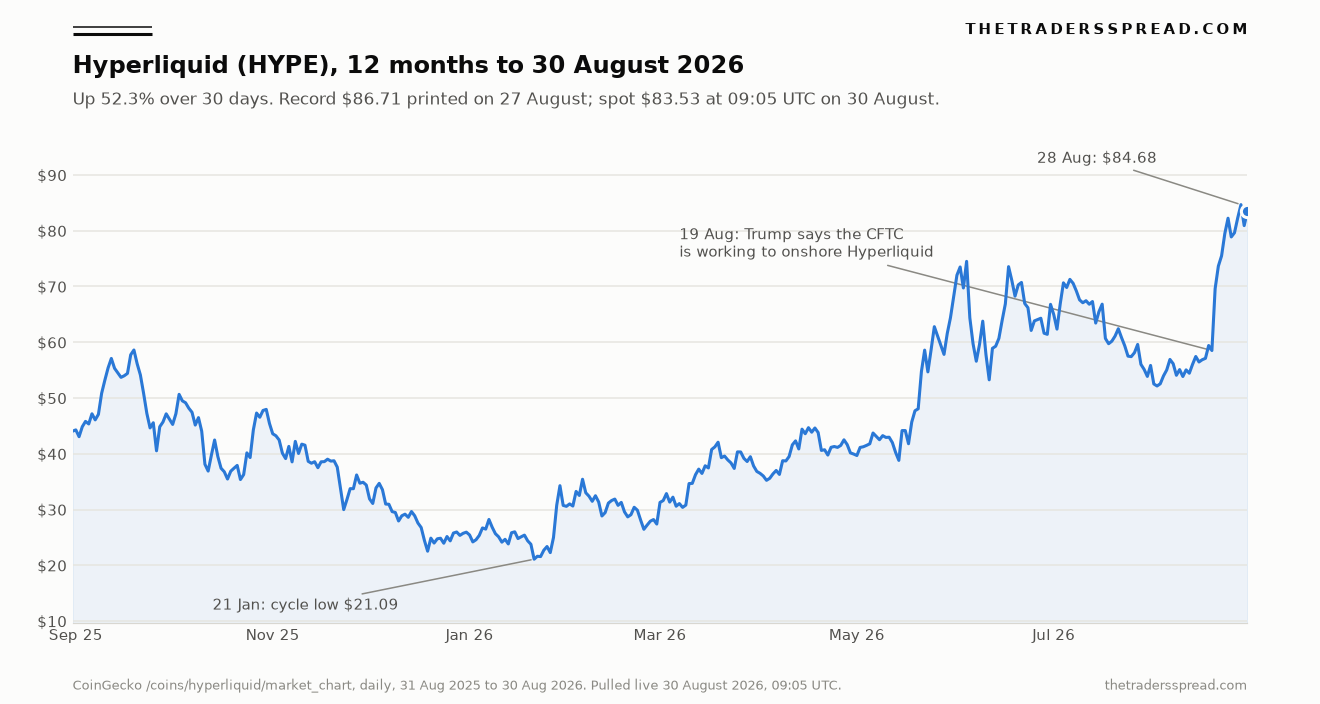
Hyperliquid (HYPE) did not climb 52% in the 30 days to 30 August because retail rediscovered a perpetuals venue. It climbed because two American regulators were publicly invited to decide what it is. The token traded at $83.53 at 09:05 UTC on 30 August, against $53.88 a month earlier, a gain of 52.3% that carried it to a record $86.71 on 27 August and a market capitalisation of $18.58bn, ninth-largest in crypto. Almost the entire move is concentrated in a single session: HYPE closed 19 August at $58.52 and 20 August at $69.60, a one-day advance of 18.9%. The catalyst was not a product, a listing or an unlock. It was a sentence spoken at the White House.
What almost nobody covering the rally has measured is where the growth actually sits. A direct pull of Hyperliquid's own metaAndAssetCtxs endpoint at 09:15 UTC on 30 August returns 232 markets on the core venue carrying $9.99bn of open interest, and ten separately deployed builder venues carrying a further $3.50bn across 274 markets. The builder layer, created by HIP-3, therefore holds 26.0% of all open interest on Hyperliquid while generating only 10.8% of its 24-hour notional volume. That is not a trading business growing faster than the core. It is an inventory business: equity, index, commodity and pre-IPO exposure that institutions put on and leave on. Five of the ten builder venues turned over precisely nothing in the same 24 hours. The growth is real, and it is narrower and stickier than the headline volume figures imply.
Key facts
- HYPE traded at $83.53, up 52.3% over 30 days and 5.5% over seven, with a market cap of $18.58bn — CoinGecko, pulled 30 August 2026, 09:05 UTC.
- The single-session move came on 20 August: $58.52 to $69.60, or 18.9% — CoinGecko daily series, 31 August 2025 to 30 August 2026.
- Trump said on 19 August that CFTC Chair Michael Selig was working to bring Hyperliquid into the United States "in a fully compliant and legal fashion" — The Block, 19 August 2026.
- Total open interest across the core venue and all ten builder venues stood at $13.49bn on 506 markets — Hyperliquid API, 30 August 2026, 09:15 UTC.
- The protocol's Assistance Fund address held 46,877,836 HYPE, worth $3.92bn, or 4.69% of the one-billion maximum supply — Hyperliquid
spotClearinghouseState, 30 August 2026. - 436.3 million HYPE is staked across 34 validators, equal to 45.7% of total supply; the Hyper Foundation operates five of those validators holding 48.7% of all stake — Hyperliquid
validatorSummaries, 30 August 2026. - Hyperliquid Strategies (PURR) traded 38.0 million shares on Nasdaq on 28 August, roughly $441m of turnover — stockanalysis.com quote data, session of 28 August 2026.
The two sentences that repriced a $18bn asset
The sequence is unusually tight. On 18 August the Hyperliquid Policy Center and the trading platform trade[XYZ] filed a 15-page comment letter with the Securities and Exchange Commission asking it to build a framework for what the letter calls IPOPs, or pre-IPO perpetual contracts. These are cash-settled instruments referencing an expected public listing, settling in USDC, conveying no shares, no votes and no IPO allocation.
The letter does something more consequential than request permission. It asks the SEC and the Commodity Futures Trading Commission to decide jointly whether equity-linked perpetuals are security futures or security-based swaps, because that classification determines registration, venue, clearing and margin treatment. It then proposes five rule pillars covering product disclosures, listing eligibility, investor access and market integrity, per crypto.news. The Policy Center, founded in February 2026 and run by chief executive Jake Chervinsky, had already met the SEC's Crypto Task Force on 14 July.
The following day, at a White House press conference with technology executives and agency chairs, the President said: "I understand Mike [Selig] is also working to bring Hyperliquid into the United States in a fully compliant and legal fashion." Selig, the CFTC chair, added his own framing: "We want to create a path to bring these onchain markets into the United States and make sure they comply with some form of regulation." The CFTC convened its first Innovation Advisory Committee the next morning.
Neither statement approves anything. What they did was convert a probability into a schedule. A venue that had been structurally excluded from the largest pool of regulated derivatives capital in the world was named, from the podium, as a candidate for inclusion. Markets price schedules faster than they price permissions, which is why the move arrived in a single session rather than being distributed across the review period. The same asymmetry has shown up repeatedly this month in rate-sensitive assets, where an unexpected shift in Fed expectations repriced the curve long before any decision was taken.
Who moved, and through which wrapper
The response was visible almost entirely through listed instruments rather than on-chain flow. Three exchange-traded products referencing HYPE now trade in the United States, and all three sit within reach of 52-week highs after the August move. The Bitwise Hyperliquid ETF (BHYP) began trading on NYSE Arca on 15 May 2026 with a 0.34% sponsor fee, and stakes the fund's HYPE through Bitwise's in-house division, Bitwise Onchain Solutions, making it the only HYPE product in the US whose sponsor runs its own staking infrastructure, according to Bitwise.
The larger vehicle by turnover is not an ETF at all. Hyperliquid Strategies trades on Nasdaq under PURR and functions as a treasury company, reporting 29.3 million HYPE held and roughly $1.9bn of HYPE holdings as of 30 June, alongside $305.5m of net income. On Friday 28 August it traded 38.0 million shares at a $11.61 close, around $441m of turnover in one session against a 52-week low of $3.01. Readers who have followed the mechanics of crypto treasury equities will recognise the structure and its hazards from our work on MicroStrategy's bitcoin position, where the equity's premium to net asset value proved far more volatile than the coin underneath it.
Institutional custody is present on the validator set too. Anchorage By Figment operates the largest non-foundation validator with 30.2 million HYPE delegated at a 10% commission, which is the plumbing an ETF sponsor needs before it can credibly promise staking yield inside a 1940-Act-adjacent wrapper. That is the same institutional-rails pattern that drove the Solana ETF complex past $1bn in assets earlier this month.
What the exchange data actually shows
Two numbers from the live pull deserve more attention than the price. First, HYPE's own perpetual is the second-largest open-interest market on the exchange that issues it, at $2.01bn, behind bitcoin's $2.91bn and ahead of ether's $1.93bn. A venue whose own token carries more leveraged exposure than ether is a venue with a concentrated reflexivity problem, because the collateral, the fee token and the most-crowded position are the same asset.
Second, the builder layer is where the new markets live, and its composition is nothing like the core. On the trade[XYZ] venue alone, 117 markets carried $3.47bn of open interest on $214m of daily volume — an open-interest-to-volume ratio above 16, against roughly 4.5 on the core venue. Its single largest market by turnover was SK Hynix at $34.8m of volume and $327.6m of open interest, followed by an S&P 500 contract at $389.2m of open interest. Those are positions, not trades.
| Vehicle | Venue | 28 Aug close | Day change | 52-week range |
|---|---|---|---|---|
| Bitwise Hyperliquid ETF (BHYP) | NYSE Arca | $44.83 | -6.33% | $24.18 – $48.84 |
| THYP | Nasdaq | $46.17 | -6.29% | $22.54 – $50.30 |
| HYPG | Nasdaq | $28.25 | -6.22% | $18.47 – $30.71 |
| Hyperliquid Strategies (PURR) | Nasdaq | $11.61 | -9.51% | $3.01 – $14.14 |
Source: stockanalysis.com quote endpoint, session of 28 August 2026, pulled 30 August 2026.
The third data point cuts against the bullish reading. Reporting has credited part of the rally to the 26 August launch of tokenized equity spot markets on HyperCore. Those markets exist: the spot metadata returns NVDAX, SPYX, QQQX, TSLAX, AAPLX, SPCXX, SKHYX, CRCLX and others as listed tokens. Every one of them returned a null mid price and zero 24-hour volume in our pull. Four days after launch, on a weekend with US cash equities shut, the tokenized spot book is empty. The equity exposure that is trading is trading as builder-deployed perpetuals, not as tokenized shares, and those are two very different regulatory objects.
The structural question the CFTC will have to answer
Onshoring an exchange means onshoring its failure modes, and Hyperliquid's are unusual because consensus and market structure are the same system. The validatorSummaries endpoint returns 34 validators securing 436.3 million HYPE, equal to 45.7% of the 955.3 million total supply. Five of those validators are operated by the Hyper Foundation and together hold 212.4 million HYPE, or 48.7% of all stake. Three validators, taken together, control more than one third of stake; eight control more than two thirds.
In a Byzantine fault-tolerant system those two thresholds are not trivia. One third is the liveness boundary, the point at which a coordinated set can halt block production. Two thirds is the safety boundary. A US designated contract market is required to demonstrate operational resilience and to show that no small group can interrupt trading or settlement. A venue where three parties can stop the chain, and where the sponsoring foundation runs the largest bloc of stake, is going to be asked to explain that in writing.
The Assistance Fund raises a parallel question. The address at 0xfefe…fefe holds 46.88 million HYPE, $3.92bn at current prices and 4.69% of maximum supply, accumulated by directing protocol revenue into buying the token. In equity markets that would be a buyback, governed by disclosure rules, blackout periods and volume caps. On-chain it is a smart contract that a regulator has never characterised. Ethena's fee-switch debate ran into a version of the same problem, which we covered when setting out the bull and bear cases on ENA.
The SEC's own question is narrower and possibly harder. The Policy Center's letter reports that across five completed IPOP markets — Cerebras, Quantinuum, SpaceX, SK Hynix and ChangXin Memory Technologies — final perpetual prices landed within 0.44% to 7.23% of the eventual listing open, while four of the US offerings priced 10.8% to 38.4% below where the perpetual had traded the previous day. Read plainly, an unregulated 24-hour market forecast the opening print more accurately than the regulated book-build set the offer price. That is an uncomfortable exhibit to place in front of an agency whose mandate includes fair and orderly capital formation, and it is the strongest argument in the filing.
What this changes
The first consequence is that HYPE has become a regulatory-calendar asset rather than a crypto-beta asset. Its 30-day gain of 52.3% arrived while bitcoin traded at $78,061 on Hyperliquid's own book, and the correlation that matters now runs to CFTC rulemaking notices, not to funding rates. Positions sized as crypto beta are mis-sized.
The second is that the builder layer is the real exposure. If the CFTC does open a compliant path, the assets that benefit most are equity, index and pre-IPO perpetuals — precisely the contracts sitting in trade[XYZ]'s $3.47bn of open interest, and precisely the contracts that a security-futures classification would push into a registered venue that Hyperliquid does not currently operate. A favourable ruling on crypto perps and an unfavourable ruling on equity perps would be a materially worse outcome than the headline suggests.
RelatedHedera (HBAR) Price Prediction: $0.115 Bull vs $0.052 Bear
The third is concentration. HYPE's own perpetual carries $2.01bn of open interest on the exchange that mints it, the Assistance Fund holds another $3.92bn, and the foundation controls 48.7% of stake. Those three pools are not independent of each other or of the price. Any forced unwind in one propagates directly into the other two.
What to watch, in order: the CFTC's follow-through from the 20 August Innovation Advisory Committee; whether the SEC or the CFTC claims jurisdiction over equity-linked perpetuals, which the Policy Center has explicitly asked them to settle; whether tokenized spot volume on HyperCore turns positive once US cash markets reopen, because a persistently empty book would tell us the equity story is a perpetuals story only; and whether builder-venue open interest keeps compounding while the core venue's share slips. The last is the cleanest single read on whether this repricing described a real change in the business or a change in the odds of one. Both the price series and the exchange endpoints used here are public, and the check takes minutes.
FAQ
Why did Hyperliquid (HYPE) rise 52% in 30 days?
The bulk of the move came in one session. HYPE closed 19 August at $58.52 and 20 August at $69.60 after Trump said at a White House press conference that CFTC Chair Michael Selig was working to bring Hyperliquid into the United States in a fully compliant fashion. A 15-page SEC comment letter from the Hyperliquid Policy Center and trade[XYZ], filed the previous day, set the stage.
What is HIP-3 and why does it matter for HYPE?
HIP-3 lets third parties deploy their own perpetual markets on Hyperliquid's infrastructure. As of 30 August ten such venues were live, carrying 274 markets and $3.50bn of open interest, or 26.0% of the exchange's total, against 10.8% of its 24-hour volume. It is where the equity, index, commodity and pre-IPO contracts live.
Has the CFTC approved Hyperliquid in the United States?
No. Neither the CFTC nor the SEC has approved a US launch. The 19 August remarks described work in progress, and the Policy Center's SEC letter is a comment letter, which carries no response deadline and obliges the agency to do nothing. The realistic next steps are staff discussions, a further request for comment, joint guidance or formal rulemaking.
What are pre-IPO perpetuals, or IPOPs?
They are cash-settled perpetual contracts referencing a company expected to list publicly, settling in USDC. They convey no shares, no voting rights and no IPO allocation. Five have run to completion on Hyperliquid, including SpaceX, Cerebras and SK Hynix, with final prices landing within 0.44% to 7.23% of the eventual listing open.
How much HYPE does the Assistance Fund hold?
The Assistance Fund address held 46,877,836 HYPE on 30 August 2026, worth $3.92bn at $83.53 and equal to 4.69% of the one-billion maximum supply. It accumulates by directing protocol revenue into open-market purchases of the token. The balance is publicly readable through Hyperliquid's spot clearinghouse endpoint.
How concentrated is Hyperliquid's validator set?
34 validators secure 436.3 million staked HYPE. The Hyper Foundation runs five of them holding 48.7% of all stake, three validators together exceed the one-third liveness threshold, and eight exceed the two-thirds safety threshold. Anchorage By Figment is the largest independent operator at 30.2 million HYPE.
This article is analysis and information, not investment advice, and no part of it is a recommendation to buy, sell or hold any asset. Perpetual futures and cryptoassets are high-risk instruments and capital is at risk. Prices and on-chain figures were pulled live on 30 August 2026 and move continuously. Do your own research and consider taking independent, regulated advice before acting.