

The twenty-point move in the French presidential election market on 8 July 2026 was not a change of view about the far right's chances. It was a change of name. On 6 July, Polymarket's daily close had Jordan Bardella at 25.50% to become France's next president and Marine Le Pen at 8.50%. Two days later, after the Paris Cour d'appel ruled, the same two legs read Le Pen 28.75% and Bardella 5.35%. Twenty points crossed the table in a single session — and yet the combined Rassemblement National probability moved from 34.00% to 34.10%. A tenth of a point. The court decided who the RN would run. It did not, in the market's judgement, change what the RN was worth.
That is the number worth carrying into the rest of this piece, because it is the cleanest natural experiment a prediction market has produced this year. The two legs behaved as perfect substitutes: every cent that left one arrived at the other. It follows that today's split — Le Pen 33.35%, Bardella 2.55% on the venue where the contracts trade — is not two independent forecasts. It is one forecast about the RN's chances, multiplied by a second about which name appears on the ballot. Divide the first by their sum and the market is telling you it is 92.9% confident that the RN's candidate in April 2027 is Marine Le Pen. Nobody publishes that number. It falls straight out of the book, and this article tests it.
Key facts
- Polymarket's "Next French Presidential Election" event has traded $123.6m across 41 priced candidate legs, with $15.7m of resting liquidity and an end date of 30 April 2027 — Polymarket gamma-api, pulled 09:17 UTC on 30 August 2026.
- Marine Le Pen 33.35% (bid 33.3 / ask 33.4, $2.02m leg volume), up 3.8 points over the past month — same pull.
- Jordan Bardella 2.55% (bid 2.5 / ask 2.6), down 0.7 points over the month, having printed an all-time low of 2.15% on 22 August 2026 — Polymarket daily closes.
- The Paris Cour d'appel cut Le Pen's ineligibility to 45 months, of which 30 suspended, and held the 15 firm months already discharged since 31 March 2025 — Cour d'appel de Paris communiqué de presse, 7 July 2026.
- Ifop-Fiducial (fieldwork 24–25 August 2026, n=1,598) puts Le Pen first in all seven first-round configurations tested, 13 to 17 points clear of the runner-up — Sud Radio, 27 August 2026.
- The same wave has her winning every second-round pairing, from 52–48 against Édouard Philippe to 67–33 against Jean-Luc Mélenchon.
- All 41 priced legs sum to 98.65% — a 1.35-point discount rather than a bookmaker's overround, so any mispricing here has to be relative, not a level effect.
1. What the Cour d'appel actually decided
On 31 March 2025 the tribunal correctionnel de Paris, presided over by Bénédicte de Perthuis, convicted Le Pen of détournement de fonds publics in the Front National parliamentary-assistants case: four years' imprisonment with two suspended, a €100,000 fine, and five years' ineligibility carrying exécution provisoire — immediate effect notwithstanding appeal. That last clause was the whole story. Without it an appeal would have suspended the bar and the 2027 question would never have arisen.
The appeal ran for a month, from 13 January to 12 February 2026, and the ruling came on 7 July. The court convicted again, but reduced the sentence to three years with two suspended, kept the €100,000 fine, and cut the ineligibility to 45 months of which 30 were suspended. The reasoning on the remaining 15 months is what freed her, and the court set it out in its own communiqué de presse: the execution of that penalty since 31 March 2025 had "d'ores et déjà réparé l'atteinte à la probité," and to ignore that would infringe "le principe de liberté des candidatures, condition essentielle à une expression démocratique du suffrage universel" — already repaired the harm to probity, and disregarding it would breach the freedom-of-candidacy principle essential to democratic expression of universal suffrage.
The court also noted that when the facts occurred — 2004 to 2016 — ineligibility for these offences was not yet mandatory; the loi Sapin II of 9 December 2016 made it so, and made provisional execution the default.
Her counsel Rodolphe Bosselut, speaking to Public Sénat on the day, called the outcome a good beginning but said he was only "partiellement satisfait," pointing to the "réduction considérable des peines, notamment sur l'inéligibilité." Le Pen said nothing leaving the courtroom, reserving it for TF1 that evening, where she confirmed she would run, as Al Jazeera reported on 7 July 2026, and framed the residual home-detention arrangement as the real obstacle: "Quand on est candidate à la présidentielle, il faut être complètement libre de ses mouvements. Je ne peux pas dépendre d'un magistrat pour m'autoriser à me rendre à un meeting." We have covered this pattern before — a legal date that markets treat as binary when it is really a distribution — in our work on the Brazilian presidential contract.
2. Who repriced, and who stopped asking the question
The most telling response to 7 July came not from traders but from pollsters. Before the ruling, every institute tested both RN hypotheses side by side. Ifop-Fiducial's wave of 26–28 May 2026 (n=1,368) had Bardella on 34–35% in the first round against Le Pen's 32–33%. Ipsos (27–28 May 2026, n=1,500), across eight scenarios, had both in a 31–36% band. Odoxa, fielding 25–26 March 2026 (n=1,005), found that 97% of RN sympathisers rated Bardella a good presidential candidate against 88% for Le Pen.
Gaël Sliman, president of Odoxa, put the implication plainly in Public Sénat on 31 March 2026: "Jordan Bardella s'impose aussi dans l'opinion comme meilleur candidat [ce qui] compliquerait probablement une candidature de Marine Le Pen si la justice le lui permettait finalement" — Bardella is establishing himself in public opinion as the better candidate, which would probably complicate a Le Pen candidacy if the courts ultimately allowed one.
Since 7 July, the August waves from Ifop-Fiducial, Elabe and Toluna Harris Interactive have stopped testing Bardella. That is defensible — Le Pen has declared, and polling budgets are finite — but it has a consequence traders should notice. There is now no fresh, same-week comparison of the two RN candidacies anywhere in the public record. The most recent apples-to-apples evidence is three months old, and it says Bardella converts at least as well as Le Pen does. The market has priced the succession question down to 7.1% at exactly the moment the data that would test it stopped being collected.
Rim-Sarah Alouane, a legal scholar at Université Toulouse Capitole, framed the oddity for Al Jazeera on 9 July 2026: "It's quite unprecedented because she's going to run for election while serving a criminal sentence." On the succession, in the same piece: "Bardella is the guy who has always been waiting to be the frontrunner … She doesn't give up on her seat that easily." Both halves matter to the price.
3. The board, and where our fair value differs
Here is the top of the French presidential election book as pulled at 09:17 UTC on 30 August 2026, alongside our own fair values. The right-hand column is not a recommendation; it is the number we would need to see before calling a leg correctly priced.
| Candidate | Market | Leg volume | 1-month change | Our fair value |
|---|---|---|---|---|
| Marine Le Pen | 33.35% | $2.02m | +3.8 pts | 30.0% |
| Édouard Philippe | 25.50% | $1.37m | flat | 31.0% |
| Jean-Luc Mélenchon | 14.50% | $1.26m | +1.5 pts | 5.0% |
| Gabriel Attal | 4.25% | $2.06m | +0.5 pts | 7.0% |
| François Hollande | 3.25% | $1.55m | −0.35 pts | 4.0% |
| Jordan Bardella | 2.55% | $1.94m | −0.7 pts | 4.0% |
| Bruno Retailleau | 1.75% | $2.04m | −0.9 pts | 3.5% |
| Raphaël Glucksmann | 1.95% | $1.52m | +0.2 pts | 3.5% |
| 28 remaining legs | 4.40% | — | — | 6.2% |
Two structural points first. The book sums to 98.65%, not the 105–115% a sportsbook would show. There is no vigorish to strip out, so every apparent edge here is a claim about relative pricing, not about the whole board. Second, the tail is thinner than it looks: 28 legs share 4.40 points, most sitting at a 0.15% mark barely above Polymarket's 0.1-cent tick. The tick floor manufactures a few points of phantom probability on its own, and the residual left for anyone outside the named field is roughly 1.35 points. France elected a president in 2017 who had founded his party twelve months earlier. A 1.35-point allowance for "none of these forty-one" is not obviously generous.
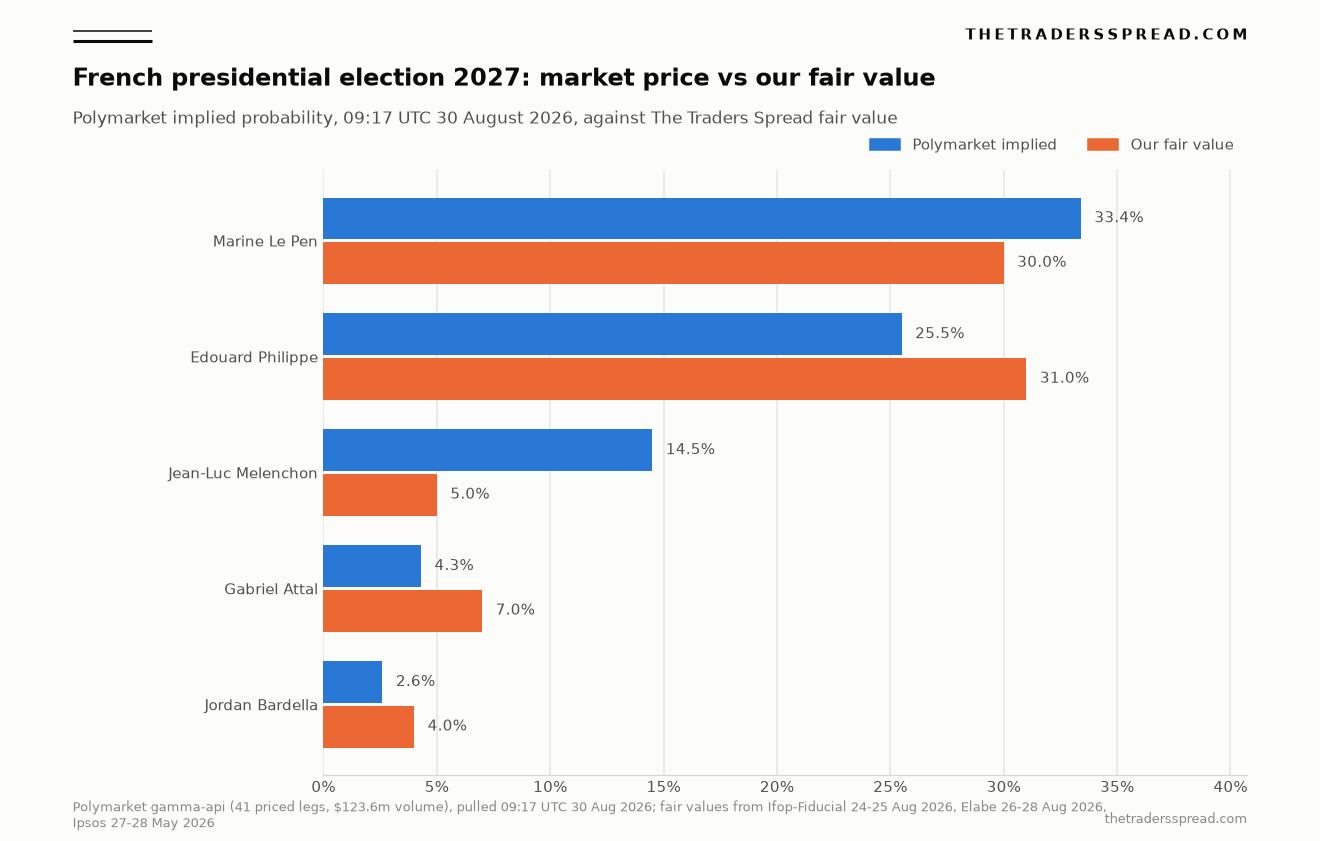
The synthesis that produces our column is straightforward. Take the market's own decomposition — the one the 8 July experiment exposed — and apply it to Le Pen. Her 33.35% is the product of three things: the probability she is on the ballot, the probability she reaches the run-off, and the probability she wins it. We put the first at 87% and the second at 86%, which is generous to her on both counts given the Ifop lead. Those two alone imply the market is assigning her a 44.6% chance of winning the second round — the same second round that Ifop-Fiducial has her winning 52–48 against Philippe and Toluna Harris has her winning 55–45. In other words, the market is already applying a haircut of five to six points of win probability to her published run-off numbers. It is not naively trusting the polls. It is discounting them, and the only real question is whether it is discounting them enough.
4. The cassation calendar, and who actually decides
The legal question is not closed. Le Pen filed a pourvoi en cassation on the evening of 7 July. A pourvoi reviews the application of law, not the facts, so the conviction itself is not in play — but the sentence and its execution are. The Cour de cassation has signalled it will move quickly, with procureur général Rémy Heitz indicating a ruling could land before the campaign proper, with early April 2027 cited as the outside date.
Set that against the electoral calendar. Article 7 of the Constitution requires the first round 20 to 35 days before the incumbent's powers expire on 13 May 2027, which puts it on Sunday 18 April and the run-off on 2 May — calculated from the rule, not yet decreed. The 500 parrainages must reach the Conseil constitutionnel by 18h00 on the sixth Friday before the first round — 12 March 2027 on the expected calendar — with the validated candidate list published the following Tuesday. A cassation ruling in "early April" therefore arrives after the candidate list is fixed — a sequencing risk the market's 7.1% does not obviously accommodate.
Worse, French jurists do not agree on whether the pourvoi is suspensive in this specific configuration, a dispute Public Sénat canvassed at length. Olivier Cahn, professor of criminal law at Université Paris Nanterre, argues that the 2026 appeal ruling erased the first-instance judgment and did not itself order provisional execution, so nothing revives the bar. Others point to a Cour de cassation ruling of 28 September 1993 for the opposite proposition. Alexis Bavitot, a criminal-law lecturer at Université Lyon 3, makes the point that matters most for a trader: ultimate authority over whether a candidacy is valid rests with the Conseil constitutionnel, which is not a criminal court and need not adopt the criminal courts' reasoning. Three institutions, three timetables, one ballot deadline.
There is also a party dimension. The RN holds its congress in Orléans on 24–25 October 2026, with electronic member voting running through late September and October. Bardella stands unopposed for re-election as party president on 421 internal endorsements. That is a leadership contest, not a candidate selection — but it puts him in front of the membership for a month, at the point in the cycle when a party that has lost three presidential elections with the same candidate might ask itself a question. Jean-Philippe Tanguy, an RN member of the National Assembly, described the relationship to Al Jazeera on 9 July as "like Russian nesting dolls. Jordan Bardella is part of Marine Le Pen's political doctrine." Nesting dolls are interchangeable in shape and different only in size.
5. Where the price sits against fair value
Our reading of the 2027 book is that the level is broadly sane and the distribution inside it is not.
Marine Le Pen at 33.35% sits above our 30%. The gap is not large and it is not a disagreement about her lead — we accept the Ifop and Harris first-round numbers at face value. It is a disagreement about the run-off. The market's implied 44.6% chance of winning the second round applies roughly a two-to-three point correction to her polled two-way share. Both prior cycles say the correction should be bigger, and the evidence is unusually direct. Fifteen months before the 2022 vote, Harris Interactive (19–20 January 2021, n=1,403) had Macron beating Le Pen by just 52–48. The actual margin was 58.55–41.45 — a drift of 13 points. Go back further and it is worse for her: Ifop-Fiducial (12–14 April 2016, n=1,876) and Odoxa (14–15 April 2016, n=949) both had Le Pen beating the sitting president, François Hollande, 53–47 in a hypothetical run-off. Twelve months later she took 33.90%. And the final-week polls of both cycles missed in the same direction: every published second-round poll in the last week overstated Le Pen's eventual score, by 3.1 to 7.1 points in 2017 and by 1.55 to 5.55 points in 2022. Twenty months out, a five-point haircut is a small one to apply to a candidate whose historical problem has never been reaching the second round.
Jean-Luc Mélenchon at 14.50% is the loudest number on the board. He is the third-largest leg in a $123.6m book and loses every published run-off pairing by 24 to 34 points. To win he must survive a fragmented left — the unitary primary launched in November 2025 collapsed after the PS voted 55.5% against joining on 9 July 2026 — then overturn a 67–33 deficit against the opponent that fragmentation helps into the run-off. We make him 5%.
RelatedIran Blockade Odds at 23.5% on Polymarket Look Too High
Jordan Bardella at 2.55% is the cheapest expression of a real uncertainty. The market prices a 7.1% chance the RN's candidate is anyone other than Le Pen. Against an unresolved cassation, a candidate list that closes before the ruling lands, a party congress in October, and three-month-old polling that had him level or ahead, we make it closer to 12%, which puts his leg near 4%.
What would change our mind. A Cour de cassation ruling before the March 2027 parrainage deadline that closes the eligibility question would justify the market's 92.9% and take our Bardella number to 2%. So would one August-quality poll testing both RN names side by side and showing Le Pen clearly ahead. On the other side, a second-round poll putting Le Pen above 55% against Philippe — rather than the 52–48 that is currently her tightest pairing — would move our 30% up, not down. And if the left consolidates behind Mélenchon, our 5% on him is too low by half.
On how event contracts reprice around a scheduled decision, our notes on the September Fed contract and on geopolitical event pricing cover the same ground on shorter horizons; the rest of our work sits in the markets hub.
FAQ
Is Marine Le Pen legally allowed to run in 2027?
As matters stand, yes. The Paris Cour d'appel ruled on 7 July 2026 that the firm 15-month portion of her 45-month ineligibility had already been served under the first-instance provisional-execution order running from 31 March 2025, and declined to extend the bar. She has filed a pourvoi en cassation, and French jurists disagree publicly about whether that filing suspends anything. The Conseil constitutionnel, not the criminal courts, validates candidacies.
Why did the odds swap between Le Pen and Bardella on 8 July?
Because the market treated them as substitutes for one RN candidacy. Le Pen went from 8.50% to 28.75% and Bardella from 25.50% to 5.35%, while the two added together moved from 34.00% to 34.10%. The ruling changed the identity of the candidate, not the party's assessed chances.
What does the 33.35% / 2.55% split actually imply?
Divide 33.35 by their sum of 35.90 and you get 92.9%. If Bardella would convert an RN candidacy into a presidency at roughly the same rate Le Pen would — which is what every side-by-side poll before July 2026 indicated — then 92.9% is the market's confidence that Le Pen is the name on the April 2027 ballot.
Do the odds add up to 100%?
Not quite. The 41 priced legs sum to 98.65%, leaving about 1.35 points for a candidate outside the named field. There is no overround, which is the main structural difference between a prediction market book and a sportsbook one, and it means the interesting question is always which leg is mispriced relative to the others.
How reliable is French polling twenty months out?
Poorly, on the historical record. In mid-December 2015, roughly sixteen months before the 2017 vote, Ifop had Alain Juppé on 30%, Le Pen on 26% and François Hollande on 20.5%. None of the three reached the second round. The current numbers are well-sampled and consistent across institutes; they are not a forecast of April 2027.
When does the market resolve?
The Polymarket event carries an end date of 30 April 2027. The election itself is expected on 18 April and 2 May 2027, with the décret de convocation due around February 2027 and the parrainage deadline calculated at 12 March 2027.
Disclaimer
This article is analysis and information only. It is not financial, investment or betting advice, and nothing in it is a recommendation to enter, exit or size any position. Prediction-market contracts can settle at zero and capital is at risk. Prices were pulled live from the Polymarket gamma-api at 09:17 UTC on 30 August 2026 and will have moved. Links to Polymarket in this article are affiliate links.