

Calling every Revolut share order commission-free runs into Revolut Trading Ltd's own cost disclosure, which gives a Standard customer one commission-free order in a rolling month and then charges 0.25% of the order amount.
The figures below come from Revolut's published pricing and legal pages and from the Financial Conduct Authority's public firm file, retrieved on 27 November 2026. No account was opened and no trade was placed. A rolling month, on the trading-fees page, resets with the plan's billing cycle. Ex-ante, the label on the cost PDFs, means the charge is shown before the order is sent. Data as of 27 November 2026.
Key figures on the card
- The stock contract names Revolut Trading Ltd on the UK-listed shares disclosure and on the US-listed shares disclosure.
- The register file, as at the close of business on 26 November 2026, lists Revolut Trading Ltd as Authorised under firm reference 933846, first authorised on 18 November 2024.
- Free orders in a rolling month run Standard 1, Plus 3, Premium 5, Metal 10 and Ultra 10, then 0.25% for Standard through Metal, with Ultra at 0.12% on the help page and Trading Pro at 0.12% for £15 a month on the cost PDFs.
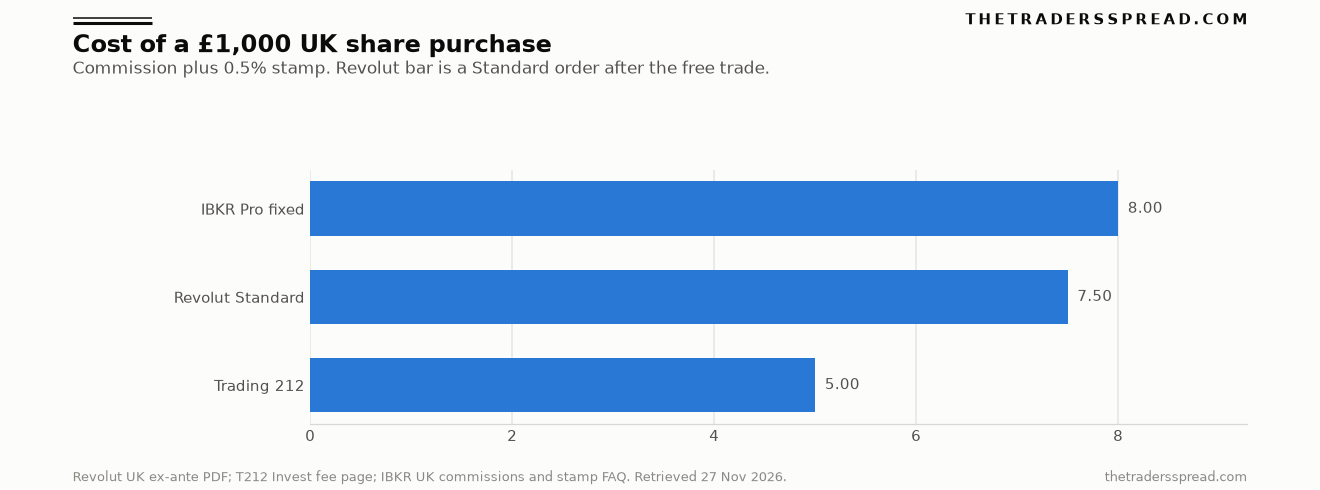
- A £1,000 purchase of a stampable UK share, on Standard after the free order, comes to £2.50 of commission plus £5.00 of stamp, £7.50 together, against £5.00 of stamp at Trading 212 and £8.00 at Interactive Brokers Fixed SmartRouting.
- A US sale on the help page carries an SEC fee of $20.60 per $1,000,000 from 4 April 2026, with the page's example at $0.02 on a $1,000 sale, while the US cost PDF still prints $27.80 per $1,000,000.
- Currency conversion uses Revolut Ltd's rate, and Standard pays 1% on exchanges over £1,000 in the month and 1% from 17:00 Friday to 18:00 Sunday, Eastern Time.
The name on the stock contract
The app shows one brand, and the stock documents name a narrower firm. The UK disclosure says Revolut Trading Ltd is authorised and regulated by the Financial Conduct Authority and provides a non-advised service in whole UK-listed shares and in fractions of those shares. Non-advised means the firm takes the order and the share choice stays with the customer. Costs apply equally to a general investment account and to an individual savings account, the UK wrapper that shelters eligible investments inside its annual allowance. The US disclosure uses the same firm name for US-listed shares.
The authorised-firms file on the Financial Services Register, downloaded on 27 November 2026, is dated at the close of business on 26 November 2026. The row is 933846, Revolut Trading Ltd, legal entity identifier 213800F913L5VYSWEJ15, Authorised, 2024-11-18. The interactive firm page returned a CSS error, so the reference recorded here is that file row. The cost PDFs say Revolut Ltd may charge a paid plan and that Revolut Ltd sets the exchange rate. Share orders sit with Revolut Trading Ltd, and plan price and foreign exchange sit with Revolut Ltd.
A separate ex-ante hub, versions from 9 November 2026, sits under a Revolut Securities Europe UAB folder. A UK reader who prices a London share from that hub is on the European card. Revolut Trading's best-execution disclosure says the firm receives and transmits orders through DriveWealth, LLC, GTN Asia Financial Services (Pte) Limited, and Upvest Securities GmbH, while the cost card stays with Revolut Trading Ltd. Reading the register name apart from the fee card is also the point of the desk's note on how eToro separates its FCA entity from the fee card.
One free order, then a percentage
Both stock disclosures print one allowance: Standard one commission-free transaction a month, Plus three, Premium five, and Metal and Ultra ten each. The trading-fees help page repeats those quotas and ties the reset to the billing cycle, and the UK plans page prints the same 1, 3, 5, 10 and 10 stock trades. After the allowance, both disclosures set 0.25% of the order amount for Standard, Plus, Premium and Metal, and 0.12% for Ultra and Trading Pro. The help page matches the 0.25% group and names Ultra at 0.12%, while Trading Pro is in the PDFs at £15 a month and the help-page sentence names Ultra alone, so someone paying the £15 has the PDF's 0.12% line to set beside that page.
The help page states a minimum fee of £0.01, and on a £1,000 order the 0.25% charge is £2.50, so the penny floor leaves that sum unchanged. The UK disclosure charges the variable fee in pounds and the US disclosure charges it in dollars, each using the Revolut rate when the order is received. Both disclosures put custody and inactivity at zero, and custody is the charge for holding the shares. A reader comparing holding costs can set that zero beside the desk's note on DEGIRO custody fees and exchange charges. The allowance counts orders, so a UK purchase and a US purchase in one rolling month put one Standard order inside the free slot and one outside it.
The plan price the illustration still uses
The UK plans page on 27 November 2026 lists Standard as free, Plus at £3.99 a month, Premium at £8.99, Metal at £16.99 and Ultra at £60. The disclosures treat a paid subscription as an ongoing cost that Revolut Ltd may charge, and the trading piece of that bundle is the larger allowance and, for Ultra, the lower percentage afterwards. The illustrations still multiply Metal by £14.99 a month. Twelve times £14.99 is £179.88, and twelve times the live £16.99 is £203.88. That multiplication is ours, and the £24 gap is what a reader gets by copying £179.88 into a current comparison.
Standard's plan price is zero, so one share order in a billing cycle has a published commission of zero while stamp on a UK purchase still applies, and the second order switches on the 0.25% line.
A £1,000 purchase of a UK-listed share
The worked purchase is £1,000 of one UK-listed share inside the stamp net. Stamp duty reserve tax, SDRT, is the UK tax on the agreement to buy those shares. The UK disclosure applies 0.5% to the buy value, so £1,000 carries £5.00, and the regulatory-fees help page states the same 0.5%. The order is under £10,000, so the £1.50 levy is zero. With the free order already used, commission is £2.50 and the two lines together are £7.50. With the free order still open, commission is zero and the cash charge is the £5.00 of stamp.
The Panel on Takeovers and Mergers levy is a flat charge tied to the body that regulates UK takeovers. The UK disclosure places £1.50 on buy transactions over £10,000, the help page says £1.50 on transactions over £10,000, and the disclosure then says these fees, where applicable, are taken on sell orders from the proceeds. An order over £10,000 needs the on-screen breakdown to show whether £1.50 lands on the buy, the sell, or both. Trading 212's page says most AIM stocks are exempt from stamp and that gilts, bonds and ETFs carry stamp of zero, while Revolut states 0.5% for purchases of UK-listed shares, so the £5.00 figure is for a stampable share.
| Revolut line verified | Figure | Where it was read |
|---|---|---|
| Firm on the stock contract | Revolut Trading Ltd | UK and US ex-ante disclosures |
| Register status | Authorised, FRN 933846, from 18 November 2024 | FCA file, close of business 26 November 2026 |
| Free orders | Standard 1, Plus 3, Premium 5, Metal 10, Ultra 10 | Both disclosures, trading-fees page, plans page |
| Commission after the allowance | 0.25% Standard to Metal; 0.12% Ultra and, on the PDFs, Trading Pro | Both disclosures; help page names Ultra at 0.12% |
| Trading Pro subscription | £15 a month | Both disclosures |
| UK stamp on a purchase | 0.5% of the buy value | UK disclosure and regulatory-fees page |
| PTM levy | £1.50 on a PDF buy over £10,000; help page says transactions over £10,000 | UK disclosure and regulatory-fees page |
| US SEC fee, cost PDF | $27.80 per $1,000,000 sold, rounded up to the nearest cent | US disclosure |
| US SEC fee, help page | $20.60 per $1,000,000 from 4 April 2026; example $0.02 on a $1,000 sale | Regulatory-fees page |
| FINRA fee, cost PDF | $0.000166 per share, minimum $0.01, maximum $8.30 | US disclosure |
| FINRA fee, help page | $0.000195 per share from 1 January 2026, minimum $0.01, maximum $9.79 | Regulatory-fees page |
| Outgoing US transfer | $35 per open position; incoming fee at zero | US disclosure |
| Live monthly plan prices | Free, £3.99, £8.99, £16.99, £60 | UK plans page, 27 November 2026 |
| Metal price inside the illustrations | £14.99 a month | UK and US disclosures |
Where the annual illustration slips
Scenario C is a busy Standard customer, 12 transactions a month, purchases at £1,000 and sales at £1,100. The summary calls the year 144 rounds, a round being a purchase plus a sale, and multiplies the £100 gain by 144 to print £14,400. The commission line charges 0.25% after one free transaction, written as five purchases at £1,000 and six sales at £1,100, times 12, which is £11,600 a month. Twelve times £11,600 is £139,200, and 0.25% of that is the £348 the page prints. The sum matches 144 orders, 132 of them charged, and 72 purchase-and-sale pairs, so a £100 gain on each pair is £7,200, half of £14,400, because 144 rounds would be 288 orders.
Scenario D, busy Metal, prints the same £14,400 gross line, while commission is 0.25% of £2,100 times 12, or £63, and £2,100 is one charged purchase and one charged sale after ten free orders. Stamp in both scenarios is 0.5% of £1,000 times 12, printed as £60, which fits twelve purchases and the 72-pair year. The £1,000 ticket is taken from the rate lines, 0.25% and 0.5%, and the printed net-return percentages stay on the PDF. The plan-fee line, still on £14.99, disagrees with live Metal at £16.99.
A $1,000 US share, and two SEC rates
The US ticket is a $1,000 purchase drawn as 10 shares at $100, then a sale of those 10 shares at the same $100, so a per-share fee has a quantity. With the Standard allowance used, 0.25% is $2.50 on the purchase and $2.50 on the sale. An American depositary receipt can also carry about $0.01 to $0.05 a share, passed through, and a common share on this ticket sits outside that range.
The US disclosure says the Securities and Exchange Commission levies $27.80 per $1,000,000 sold, rounded up to the nearest cent, and that FINRA charges a trading activity fee of $0.000166 per share, minimum $0.01, maximum $8.30. On a $1,000 sale the PDF rate is $0.0278, which rounds up to $0.03, and ten shares fall under the $0.01 minimum. The regulatory-fees page dates another pair. From 4 April 2026 the SEC fee is $20.60 per $1,000,000, and the page's example is $0.02 on a $1,000 sale, against a raw product of $0.0206. From 1 January 2026 the per-share fee is $0.000195, minimum $0.01, maximum $9.79, so ten shares again take $0.01. The help page names the 2026 dates, the PDF is the document the agreement lists, and the order screen is the charge.
The currency line sits with Revolut Ltd
A UK share is priced in pounds, so a sterling balance stays in pounds on that purchase, while a US share is priced in dollars. The US disclosure says a conversion may be required and that Revolut Ltd sets the rate shown in the app at the moment of conversion. Commission on the worked ticket stays in dollars, and the currency percentages stay in pounds.
The exchange-fees help page and the Standard fees page put Standard's weekday limit at £1,000, then 1%, and Plus at £3,000, then 0.5%. Premium, Metal and Ultra are described with an unlimited limit and a fair-usage fee of zero. The limit pools fiat, crypto and commodity exchanges, including an automatic exchange, and the stock disclosures say funding exchanges count for Standard and Plus and sit outside the limit for Premium, Metal and Ultra. From 17:00 Friday to 18:00 Sunday, Eastern Time, Standard pays 1% on the whole exchange and Plus pays 0.5%, with the fair-usage fee on top of that mark-up. A lone £1,000 Saturday conversion is £10 of weekend charge, and the same £1,000 on a Wednesday inside the limit has both published percentages at zero.
RelatedHow Vantage Prices a EUR/USD Ticket by Legal Entity
The same ticket on two other schedules
The peer ticket uses the same notionals. Revolut is Standard with the free order already used, on a weekday, inside the £1,000 exchange limit. Trading 212's fee page says the only fee it can charge is the 0.15% FX fee, with commission free and custody free, stamp at 0.5% on London share purchases, and a £1.50 PTM levy on a purchase and a sale over £10,000. The £1,000 UK purchase is £5.00 of stamp. A $1,000 US purchase that converts pounds costs $1.50, and an order already in dollars drops the 0.15%. The page footer names Trading 212 UK Ltd and reference 609146.
The SEC sentence on that page says $0.00206 of the sell order, which on $1,000 is $2.06, and the FINRA line is $0.000195 times quantity, so 10 shares are $0.00195. Revolut's help page is $0.0000206 per dollar from 4 April 2026, and Interactive Brokers' US commissions page prints the same $0.0000206, or $0.0206 on $1,000. The Trading 212 coefficient is one hundred times those two, and the page says the fees appear on the order screen before confirmation. Interactive Brokers' Europe stock page prices Fixed SmartRouting at 0.05% with a £3.00 minimum, so the £1,000 commission is £3.00, and the firm's UK-stock FAQ adds 0.5% stamp on top, which makes £8.00. Ten US shares on the Pro Fixed schedule take the $1.00 minimum. The trading activity fee is printed at $0.00 through a holiday that runs to 31 December 2026. A $1,000 spot conversion on that firm's currency page costs the $2.00 minimum, against about $0.30 when the rate moves by 0.03%.
The same split between commission and tax is set out in the desk's note on four Hargreaves Lansdown charges on a single share deal, and another app allowance is in the comparison of what the Freetrade and Lightyear schedules each bill. If the free Revolut order is still open and is spent on the UK purchase, that purchase is £5.00, level with Trading 212, because the stamp remains.
| Worked ticket | Revolut Standard, free order used | Trading 212 Invest | IBKR Pro Fixed |
|---|---|---|---|
| £1,000 UK purchase, commission | £2.50 | £0.00 | £3.00 |
| Stamp at 0.5% | £5.00 | £5.00 | £5.00 |
| PTM levy under £10,000 | £0.00 | £0.00 | £0.00 |
| UK purchase, commission plus stamp | £7.50 | £5.00 | £8.00 |
| $1,000 US purchase, 10 shares at $100 | $2.50 | $0.00 | $1.00 |
| Conversion for that US purchase | Weekday fair-usage fee of zero inside £1,000; weekend 1% | 0.15% if pounds are converted, $1.50; zero if already in dollars | Automatic conversion about $0.30; spot minimum $2.00 |
| SEC fee on a $1,000 sale | Help-page example $0.02; PDF rate rounds $0.0278 up | Printed $0.00206 of the sale, which is $2.06 | $0.0000206 times the sale, which is $0.0206 |
| Per-share sale fee, 10 shares | Help page $0.000195, so the $0.01 minimum | $0.000195 times 10, which is $0.00195 | $0.00 during the fee holiday through 31 December 2026 |
Questions the card still leaves open
Does one free order cover a UK share and a US share in the same month?
The allowance counts orders across the investment account, and a purchase is an order and a sale is an order. Standard's published count is one commission-free order in the rolling month, so a UK purchase and a US purchase put one of the two on the 0.25% line, while Metal's ten and Ultra's ten can hold both and the rate after the allowance stays 0.25% on Metal and 0.12% on Ultra.
Why is a commission-free UK purchase still £5?
The £5.00 is stamp duty reserve tax at 0.5% of a £1,000 purchase, and Revolut's UK disclosure, Trading 212's Invest page and Interactive Brokers' UK-stock FAQ each state that rate on top of commission. Commission on the free order can be zero, and the tax on a stampable share remains. Above £10,000 the further question is the £1.50 levy on the Revolut disclosure's buy transactions over that size.
Which SEC fee will a US sale actually use?
The US cost PDF prints $27.80 per $1,000,000 sold, and the regulatory-fees page prints $20.60 per $1,000,000 with an example of $0.02 on a $1,000 sale, beside $0.000195 a share against $0.000166 in the PDF. The fee breakdown is shown before the order is submitted, and that screen is the charge for the order.
A checklist before the order screen
- The stock terms name Revolut Trading Ltd, Authorised under 933846 as at 26 November 2026, while the plan price and the exchange rate are described as Revolut Ltd's.
- Count the free orders left in the rolling month, because Standard has one and the next order is 0.25% through Metal, or 0.12% for Ultra on the help page.
- On a UK share purchase, add 0.5% stamp, and above £10,000 read whether the £1.50 levy lands on the buy, the sell, or both.
- On a US sale, set the PDF rate of $27.80 per million beside the help page's $20.60 per million, then read the breakdown on that order.
- A weekday exchange inside the £1,000 Standard limit has a fair-usage fee of zero, and the Friday-to-Sunday window adds 1% for Standard on the whole amount.
- On this £1,000 UK purchase the totals are £7.50, £5.00 and £8.00, with £5.00 of each in stamp, and live Metal at £16.99 stays off that sum unless the plan is held for the allowance.
The schedules above are analysis, not advice, and capital put into shares can be lost.