
Every Australian broker comparison table treats Fusion Markets and Global Prime as rivals. The national business register says they are one legal entity. ABN 74 146 086 017 was registered as GLOBAL PRIME PTY LIMITED from 21 October 2010 until 15 August 2023, when it was renamed FMGP TRADING GROUP PTY LTD. It carries two registered business names today: "Global Prime" from 15 August 2023 and "Fusion Markets" from 4 September 2023. That ABN sits on the cover of Fusion Markets' own Australian Product Disclosure Statement, above Australian Financial Services Licence 385620. This is lawful, disclosed on a public register, and running two brands under one licensee is ordinary practice. It is also not what the comparison tables imply.
The documents show a second thing: Fusion Markets' headline price is a currency artefact, not one number. Its raw-spread Zero account charges US$2.25 per side, US$4.50 round turn — and an identical A$4.50 on Australian-dollar accounts. At the European Central Bank's AUD/USD reference rate of 0.71946 for 28 August 2026, that Australian schedule is US$3.24, roughly 28% below the US-dollar one for the same trade. Fusion attributes the parity to legacy, saying it froze the AUD rate at launch in June 2019 "despite the exchange rate being very different." The rates say otherwise: AUD/USD averaged 0.69438 across June 2019, so the discount was about 31% then and 28% now. It has narrowed, not appeared. The cheapest way to trade here has been the base currency, not the account type, for seven years.
Key facts
- One entity, two brands. ABN 74 146 086 017 was Global Prime Pty Limited until 15 August 2023, is FMGP Trading Group Pty Ltd today, and holds registered business names for both brands — ABN Lookup historical details, extracted 29 August 2026
- AFSL 385620, held since 5 January 2011, no suspension or cancellation flag, authorised to deal in and make a market for derivatives and foreign exchange contracts — ASIC Australian Financial Services Licensee Dataset, August 2026
- US$2.25 per side, US$4.50 round turn on the Zero account; EUR/USD average spread of 0.01 pips — fusionmarkets.com, spreads measured 1–5 June 2026, page checked 29 August 2026
- cTrader prices commission in the base currency, so one EUR/USD lot costs EUR 4.50 round turn — about US$5.24 at 1.1643, or 16% above the advertised headline — fusionmarkets.com/Platforms/cTrader
- No minimum deposit, though per-method minimums apply, from A$1 on PayID to US$20 on BinancePay — fusionmarkets.com/FAQ
- Negative balance protection is discretionary under the policy that governs it, despite marketing that says an account "can never go below zero" — Negative Balance Protection Policy v1.0, effective 23 July 2026
Three entities, and only one of them is Australian
Fusion Markets is not a single company. Four separate legal persons appear across its own documents, and which one a client contracts with sets their leverage, their protections and the law governing a dispute.
FMGP Trading Group Pty Ltd is the AFSL holder and the issuer for Australian clients. We pulled the licensee row from ASIC's published dataset rather than relying on the broker's description of it: licence 385620, ABN 74146086017, start date 05/01/2011, Sydney, authorised to advise, deal and make a market in derivatives and foreign exchange contracts for retail and wholesale clients. No end date, no condition flag. Fifteen years of unbroken licensing is a genuine credential — and it belongs to the entity that traded as Global Prime.
Fusion Markets Pty Ltd — a different company, ABN 69 622 459 161 — owns the website and acts as an authorised representative, not a licensee. Offshore, Gleneagle Securities Pty Limited trading as "Fusion Markets EN" holds Vanuatu Financial Services Commission licence 40256, listed as Active; Fusion Markets International Ltd, Seychelles company 8429725-1, sits on the Seychelles Financial Services Authority's capital markets register as a securities dealer.
One caveat there: the FSA register publishes names and addresses but no licence numbers, so the SD096 appearing throughout Fusion's own documents is not confirmable from the regulator's list.
More substantively, Fusion's Regulations page covers only the Seychelles and Vanuatu entities. The AFSL — the strongest licence in the group — appears on it nowhere, surfacing instead in the footer under "Australian Clients Only." That inverts how most brokers position themselves.
"I started Fusion because I believe our clients deserve to trade the markets for a radically lower cost than what exists today," writes Phil Horner, CEO and Founder of Fusion Markets, on the company's Who We Are page. On price, the numbers largely bear him out. On structure, they require reading.
What a lot actually costs
The Zero account is the raw-spread product: interbank pricing plus an explicit commission. Fusion's page states it plainly — "At $2.25 commissions per side and 0.0 spreads" — and the FAQ confirms "USD 2.25 per 1 standard lot or equivalent ($4.50 per round turn)." Classic folds the cost into the spread instead, quoting EUR/USD near 0.92 all in. Fusion puts total Zero cost at about 0.5 pips against roughly 0.9 on Classic.
That 0.5 figure checks out. We fetched the live data source behind Fusion's product table — a published spreadsheet the page declares as its own feed — and read the EUR/USD row directly: minimum spread 0.00, average 0.01, footnoted to 1–5 June 2026. Add a US$4.50 round-turn commission, worth about 0.45 pips on a standard lot, and the all-in cost lands near 0.46 pips. Internally consistent, and cheap.
The complication is that "US$4.50" holds only on some accounts and some platforms. Fusion publishes a commission table denominated by account currency: A$4.50, US$4.50, EUR 4.05, £3.55, S$6.20, NZ$6.90, C$6.00, ¥495. Those are nominal amounts, not conversions of one figure, so real cost varies with the currency you funded in. At current rates £3.55 is about US$4.82 and A$4.50 about US$3.24 — a spread near 50% between two clients doing the same trade. It is the quirk we documented in our FP Markets review, where flat per-currency commissions opened a 98% cost gap.
Then there is the platform. Fusion's cTrader page explains that "In MetaTrader, commissions are charged per lot. In cTrader, commissions are charged at a rate of $2.25 per $100,000 of notional volume traded (both in the base currency traded). So, in cTrader if you trade 1 lot of EURUSD… the commission will be EUR 2.25 per side or EUR 4.5 round-turn." At 1.1643 that is US$5.24, about 16% above the headline. On sterling pairs the gap is wider: GBP 4.50 round turn, roughly US$6.11, against a £3.55 MetaTrader schedule worth about US$4.82. The same page then answers "Are spreads and commissions the same on cTrader as other Fusion platforms?" with "Yes." They cannot both be right, and the detailed one is what shows up on a statement.
Where that leaves Fusion against its peers
Put the published raw-account schedules side by side and Fusion's headline holds, though by a narrower margin than its marketing suggests. The chart converts every AUD schedule to US dollars at 0.71946 so the comparison is like for like, and takes peer figures from the terms recorded in our own reviews rather than any vendor ranking.
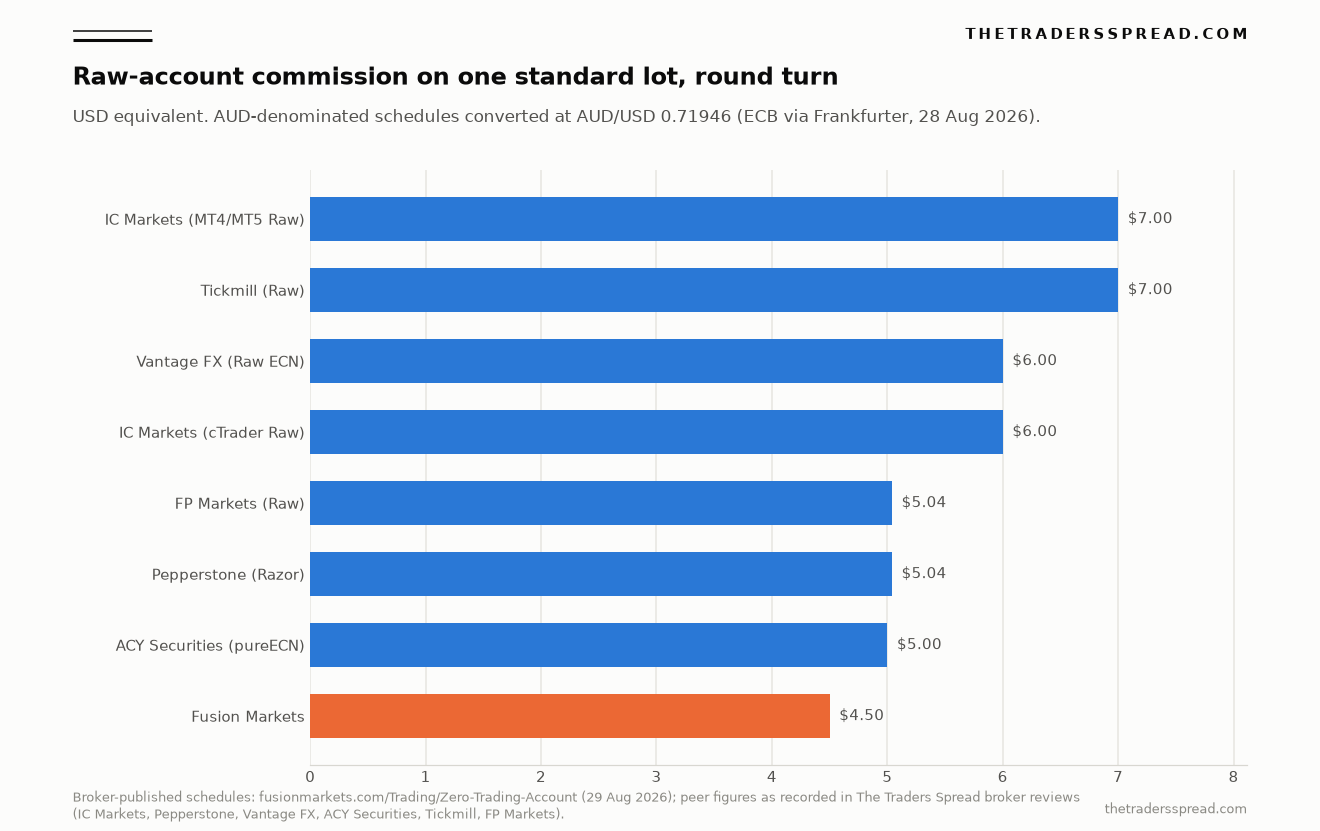
Fusion is cheapest on this measure at US$4.50, but the field is tight. ACY Securities' pureECN account is US$5.00 — though it gates that price behind a US$20,000 minimum deposit, against Fusion's none, a difference the raw number hides. Pepperstone's Razor and FP Markets' Raw both charge A$7.00, about US$5.04. IC Markets sits at US$6.00 on cTrader and US$7.00 on MetaTrader, Tickmill's Raw account at US$7.00.
| Commission basis | Round turn, 1 standard lot | USD equivalent | vs US$4.50 headline |
|---|---|---|---|
| AUD account, MetaTrader | A$4.50 | US$3.24 | −28% |
| USD account, MetaTrader | US$4.50 | US$4.50 | headline |
| GBP account, MetaTrader | £3.55 | US$4.82 | +7% |
| cTrader, EUR/USD | EUR 4.50 | US$5.24 | +16% |
| cTrader, GBP/USD | GBP 4.50 | US$6.11 | +36% |
FX at ECB reference rates for 28 August 2026: AUD/USD 0.71946, EUR/USD 1.1643, GBP/USD 1.3583. Commission schedules from fusionmarkets.com, retrieved 29 August 2026.
One claim we will not carry forward is the "36% lower than our closest competitors" line on Fusion's Why Fusion page. Its own footnote sources it to a "comparison of 40+ global FX/CFD brokers with a Tier-1 licence conducted by ForexBenchmark as of 1 August 2026," with the execution-speed claim attributed to CompareForexBrokers on the same date. Both are affiliate-model comparison sites that earn commissions from broker referrals. That does not make the figures wrong, but it makes them vendor-sponsored rather than independent, and repeating them as findings would be passing marketing off as research.
Platform coverage is genuinely broad: MT4, MT5, cTrader with Level II depth and algorithmic trading, native TradingView execution, the in-house Fusion+ copy service, DupliTrade and MAM/PAM structures — with cTrader carrying the Zero account only. Deposits run across more than thirty rails at no broker fee, including instant PayID from A$1, and withdrawals are listed at zero fee. The bank-wire caveat is disclosed: international transfers into the Australian trust account "will likely be USD $20-$30" in third-party fees Fusion does not control.
The marketing says never. The policy says maybe.
Fusion's Why Fusion page carries this, verbatim: "Our Negative Balance Protection caps your losses at your balance, so your account can never go below zero." It is an unconditional promise, stated without qualification.
The document that governs negative balance protection says something different. The Negative Balance Protection Policy version 1.0, effective 23 July 2026, opens at clause 1.1 by describing how the Vanuatu and Seychelles entities "may, at our sole and absolute discretion, offer negative balance protection ('NBP') to certain eligible clients." Clause 1.3 is explicit: "Nothing in this Policy creates, or should be interpreted as creating, a contractual right for any client to receive NBP." Clause 4.1 is set in capitals — "NBP IS NOT GUARANTEED, IS NOT AUTOMATIC, AND IS NOT A FEATURE OF EVERY ACCOUNT." The definition of an eligible client turns on "sole discretion." Clause 9.4 closes the loop: no client may claim an excluded negative balance "regardless of any representation made in marketing material, on the Company's website, or by any employee, agent, or introducing broker."
That is a direct conflict between a marketing page and a policy document, and the policy expressly overrides the marketing. Three points cut in Fusion's favour, though. First, scope: the policy applies only to clients of the Vanuatu and Seychelles entities. Clause 3.2 says so, and clause 3.3 adds that where a regulator imposes a mandatory NBP obligation, "that obligation prevails over this Policy and the Company will comply with it regardless of the discretion described below." Retail clients whose regulator makes NBP a right keep it whatever the policy says. The exposure is specific to offshore clients, not universal.
Second, the drafting is careful rather than aggressive. Clause 6A.5 acknowledges that a clawback right may be unenforceable precisely because clause 1.3 disclaims contractual status, and commits the company to obtaining explicit client acceptance so the right "is contractually founded rather than resting on this Policy alone." Clause 10.3 preserves liability that cannot lawfully be excluded, clause 5.2 caps investigative withdrawal holds at ten business days, and Schedule 1 names the seven excluded jurisdictions. Third, it is new: written in July 2026, with an amendment log. Most brokers publish no such document at all.
Which makes the contrast with the rest of the legal library sharper. The Seychelles Client Services Agreement linked from the site is dated 18 December 2025 and still carries unfilled template placeholders. Its opening paragraph says the company is "authorized and regulated by the Financial Services Authority in Seychelles ('FSA') under the license number [TO BE ADDED]" — on the licence-number line of a binding client agreement, eight months after its stated date. In fairness, the cover page does state "Number: SD096"; the information exists, it was never merged into the body. Clause 5.2 of the same agreement sets an inactivity fee "up to USD 10" chargeable annually after twelve months without transactions — a real term no page on the live site mentions.
The Vanuatu Product Disclosure Statement is dated 28 February 2022, now four and a half years old. It is also the document describing how client money is held: moneys "are held in trust for you and are segregated from Fusion Markets own funds," but within that account "Individual Clients do not have separate or segregated accounts" and "All Clients' moneys are combined into one account." Pooling of this kind is standard in retail CFD and no defect — segregation means separation from the broker's money, not from other clients'. The PDS also limits recourse to "the extent to which Fusion Markets actually recovers against its Hedge Counterparty." Client money sits with National Australia Bank, a meaningful custody credential, though NAB is named only on the website, not in the PDS.
There is no investor compensation scheme, and Fusion does not claim one. Australian clients reach the Australian Financial Complaints Authority, of which Fusion is a member; Australia has no retail compensation fund for CFDs, so that describes the jurisdiction, not the broker. Offshore clients have neither compensation nor an AFCA equivalent.
RelatedSwissquote Review 2026: 1.7 Pips Buys a Swiss Bank Licence
Leverage follows the same entity logic. The ASIC PDS reproduces the regulator's product intervention order: 30:1 on major spot FX, 20:1 on minor pairs, gold and major indices, 10:1 on other commodities and minor indices, 5:1 on equity CFDs, 2:1 on crypto. The offshore entities advertise up to 500:1 on forex and metals, throttled by equity down to 50:1 above US$1 million. The advertised headline belongs to the entity with the fewest protections — ordinary in this industry, not a scandal. Fusion also declines clients from an unusual list including Spain, New Zealand, Japan and Ontario; blanket exclusions of two ordinary regulated markets suggest licensing constraints it has not explained publicly.
The assessment
On price, Fusion Markets is what it says it is. US$4.50 round turn with no minimum deposit is the cheapest published schedule among the eight brokers compared here, the spread data comes from Fusion's own live feed rather than a marketing page, and the arithmetic reconciles. The AFSL has run uninterrupted since January 2011, the VFSC licence reads Active, the Seychelles entity is on the FSA register, the site's 184 URLs were refreshed on 26 August 2026, and the NBP policy was rewritten last month. This is a maintained business.
The gaps are gaps of consistency rather than substance. A commission described as one number that is really eight, plus a ninth on cTrader the same page denies exists. An unconditional negative-balance promise governed by a policy that disclaims it. A client agreement whose licence-number line still reads "[TO BE ADDED]." A PDS from February 2022. An AFSL the regulations page omits. Individually small; together they describe a firm whose documentation has not kept pace with its marketing.
Four things would change that reading: the cTrader page reconciled so its base-currency rule and its "Yes, they're the same" answer stop contradicting each other; the Seychelles agreement reissued with placeholders filled; the VFSC PDS refreshed; and the AFSL given the prominence the offshore licences already have. Three would worsen it: a condition or suspension against AFSL 385620, a change in VFSC or FSA status, or schedules moving without the tables moving with them. All are checkable on a public register.
The shared-entity finding is not, in itself, a criticism. Groups run multiple brands at different price points for sound commercial reasons, the arrangement sits on a public register, and nothing is concealed. It matters because of how brokers get compared. If a ranking table lists Fusion Markets and Global Prime as two independent options, the reader is being shown one counterparty twice — same licensee, same regulator, same balance sheet — and spreading business across the two spreads nothing at all.
Frequently asked questions
Are Fusion Markets and Global Prime the same company?
They are the same legal entity. ABN Lookup shows ABN 74 146 086 017 was registered as Global Prime Pty Limited from October 2010 until August 2023, was renamed FMGP Trading Group Pty Ltd, and now carries registered business names for both. That ABN and AFSL 385620 appear on Fusion's own Australian PDS. The brands operate separately; the licensee behind them is one company.
What does Fusion Markets actually charge per lot?
US$2.25 per side, US$4.50 round turn, on the Zero account on MetaTrader with a US-dollar account. It changes with your account currency — A$4.50, EUR 4.05, £3.55 are nominal amounts, not conversions — and changes again on cTrader and TradingView, where commission is charged per US$100,000 of notional in the base currency traded, making a EUR/USD lot cost EUR 4.50 round turn.
Does Fusion Markets guarantee negative balance protection?
Its website says an account "can never go below zero." Its Negative Balance Protection Policy, effective 23 July 2026, says NBP is offered "at our sole and absolute discretion" and that nothing in the policy creates a contractual right to it. The policy covers only the Vanuatu and Seychelles entities, and states that any mandatory regulatory NBP obligation prevails over its discretion — so clients whose regulator requires NBP keep it regardless.
Is there a minimum deposit or an inactivity fee?
Fusion's FAQ states there is no minimum deposit, subject to per-method minimums from A$1 on PayID. No page on the live site mentions an inactivity fee, but clause 5.2 of the Seychelles Client Services Agreement dated 18 December 2025 provides for one of "up to USD 10" chargeable annually after twelve months without transactions.
What leverage is available?
It depends on the entity. Australian retail clients are capped by ASIC's product intervention order at 30:1 on major FX, 20:1 on minor pairs and gold, 5:1 on equity CFDs and 2:1 on crypto. The Vanuatu and Seychelles entities advertise up to 500:1 on forex and metals, stepping down by account equity to 50:1 above US$1 million.
This review is analysis and information only — not financial advice, a recommendation, or an inducement regarding any broker mentioned. Figures were verified against primary sources on 29 August 2026 and may change without notice; terms, fees and licence status should be confirmed with the broker and the relevant regulator. Trading contracts for difference is high risk and can produce losses exceeding your deposit. Capital at risk.