
FP Markets is a Sydney-based forex and CFD broker, trading since 2005 through First Prudential Markets Pty Ltd under Australian financial services licence 286354. Most reviews of it stop at one number: raw spreads from 0.0 pips, commission A$3.50 per side. That number is accurate and it is also close to meaningless on its own, because FP Markets does not charge one commission. It charges eleven, one for each account base currency, and it sets them as flat nominal amounts rather than as conversions of a single figure.
Convert all eleven to a common unit and the gap is not a rounding error. On the European Central Bank reference rates for 27 August 2026, the same standard lot of EUR/USD costs US$1.88 per side in a yen-denominated Raw account and US$3.73 per side in a Swiss franc one — 98% more for an identical trade, on identical liquidity, at the same broker. The drop-down you tick during signup is worth more to your annual cost base than the spread difference between most raw-spread brokers.
FP Markets at a glance
- Licensing: First Prudential Markets Pty Ltd, ABN 16 112 600 281, AFS licence 286354 — held since May 2005 (ASIC 14-345MR; FP Markets disclosure, read 28 August 2026)
- Group entities: CySEC licence 371/18 (First Prudential Markets Ltd, HE 372179), FSCA FSP 50926 (FP Markets Pty Ltd), Seychelles FSA SD130 (FP Markets Ltd) — FP Markets regulation page, 28 August 2026
- Raw account: spreads from 0.0 pips, commission A$3.50 per side per lot on forex and metals; zero on commodities and indices — FP Markets MT4/5 Fees & Charges, 28 August 2026
- Standard account: spreads from 1.0 pip, zero commission; minimum deposit A$100 on both — FP Markets Account Types, 28 August 2026
- Retail leverage: capped at 30:1 on major FX, 2:1 on crypto under ASIC's product intervention order, in force to 23 May 2027 — ASIC 22-082MR
- Cost spread by base currency: US$3.76 to US$7.45 round turn per lot, a 98% range — our calculation from FP Markets' published schedule at ECB rates, 27 August 2026
- Regulatory history: ASIC accepted an enforceable undertaking from First Prudential Markets in 2014 over 2013 compliance processes; we found no later ASIC action naming the firm
What FP Markets actually is, and what it charges
FP Markets runs two distinct businesses under one brand, and conflating them is the most common error in reviews of the firm. The first is a conventional MetaTrader forex and CFD operation: MT4 and MT5, a Standard account priced through the spread and a Raw account priced through commission, both opening from A$100.
The second is a direct market access equities business on the Iress platform, which is unusual for a retail forex broker and is the reason FP Markets appears in conversations about Australian share CFDs at all. ASIC's own description of the model is precise: under DMA, the firm "automatically hedges its exposure to any CFD position executed by a client by taking an equivalent one-for-one position in the underlying shares". Your order reaches the exchange rather than a dealing desk.
The pricing of the two sides has almost nothing in common. On MT4 and MT5, Australian equity CFDs cost 0.05% per side with a A$5 minimum. On Iress, the same exposure costs 0.06% per side with a A$6 minimum for retail accounts, falling to 0.05% with no minimum for wholesale. Iress also carries a platform fee that MetaTrader does not.
That platform fee is where FP Markets' own documentation contradicts itself. The Account Types page lists Iress ViewPoint at A$75 including GST, waived if you generate A$150 in monthly commission. The Fees & Charges page lists IressTrader and ViewPoint at A$85 per month including GST, waived on 15 trades or A$150 in commission. Both pages were live on 28 August 2026. A A$10 monthly discrepancy is small; a broker publishing two prices for the same product is the kind of detail worth confirming in writing before funding an account.
The firm's regulatory record is longer than most reviews acknowledge. In 2014 ASIC accepted an enforceable undertaking from First Prudential Markets over concerns that, in 2013, its processes for detecting potentially manipulative client trading may not have been adequate; the undertaking required an independent compliance expert to assess and report on its controls. ASIC Commissioner Cathie Armour said at the time that the regulator "expects that licensees have appropriate and adequate compliance measures in place to maintain the integrity of and confidence in the broader market". The matter is twelve years old and was resolved through remediation rather than penalty, and we found no subsequent ASIC action naming the firm.
Where the money actually goes
Ask a broker what a trade costs and you get a spread. Ask what a year costs and the answer moves to fees that never appear in a comparison table.
On the Iress side, market data is the line item that catches people. Live ASX Level 2 data runs A$23 a month on a private account and A$135 a month on a professional one, rebated at A$50 and A$150 of commission respectively. London Level 2 is GBP 6 private against GBP 185 professional. The professional classification that unlocks higher leverage also multiplies the data bill by roughly six on ASX and thirty on LSE. Nobody discloses that trade-off in the leverage marketing.
On the MetaTrader side, the platform is free and the commission is the whole story on forex and metals — which is exactly why the base-currency question matters so much. FP Markets charges zero commission on commodity and index CFDs in both Standard and Raw accounts, building the cost into the spread, so a trader who only touches indices is indifferent to the account type in a way a forex trader is not.
Deposits are free, and FP Markets states it covers internal bank fees on international deposits, with BPAY, POLi, PayPal, Neteller, Skrill and card funding available. That is a genuine cost advantage over brokers that pass card fees through, and it is worth more to a small account than a tenth of a pip.
The regulator has landed on the same point from the other direction. Announcing the outcome of a review of 52 CFD issuers in January 2026, ASIC Commissioner Simone Constant said these are "complex, high-risk products, where most investors face losses, and even profitable trades can be entirely eroded by trading costs".
The 98% question: why base currency beats spread
FP Markets publishes its Raw forex and metals commission as eleven separate figures: A$3.50, C$3.50, S$3.50, US$3.00, EUR 2.75, GBP 2.25, HK$22.50, JPY 300, NZ$4.40, CHF 3.00 and PLN 12.20 per side per lot. Read as a list, they look like the same price expressed in different money. They are not.
Converted at ECB reference rates for 27 August 2026, they range from US$1.88 to US$3.73 per side. A yen-denominated account is the cheapest venue for the identical trade; a franc-denominated one is the most expensive, at 98% more. The Australian default that most local clients accept sits mid-table at US$2.52, while a US dollar account — the reflexive choice for many international traders — costs 19% more per side than the Australian one.
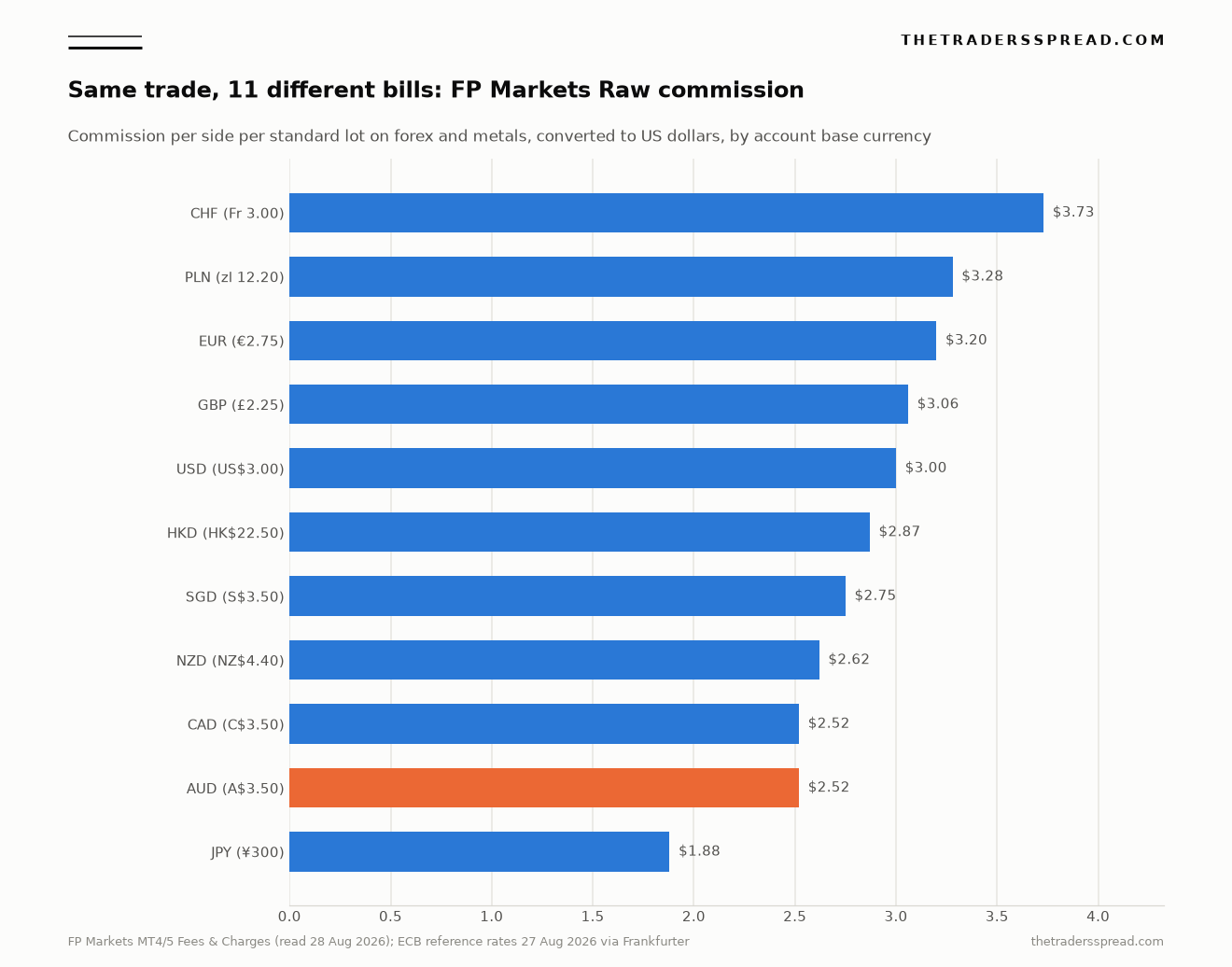
The table below annualises it. The final column is the extra commission a trader turning over 50 standard lots a month would pay against the cheapest denomination, round turn, over a year.
| Base currency | Published per side | ≈ US$ per side | ≈ US$ round turn | Extra vs JPY, 600 lots/yr |
|---|---|---|---|---|
| JPY | JPY 300 | US$1.88 | US$3.76 | — |
| AUD | A$3.50 | US$2.52 | US$5.03 | US$761 |
| CAD | C$3.50 | US$2.52 | US$5.05 | US$770 |
| NZD | NZ$4.40 | US$2.62 | US$5.24 | US$884 |
| SGD | S$3.50 | US$2.75 | US$5.51 | US$1,045 |
| HKD | HK$22.50 | US$2.87 | US$5.74 | US$1,186 |
| USD | US$3.00 | US$3.00 | US$6.00 | US$1,341 |
| GBP | GBP 2.25 | US$3.06 | US$6.11 | US$1,408 |
| EUR | EUR 2.75 | US$3.20 | US$6.40 | US$1,584 |
| PLN | PLN 12.20 | US$3.28 | US$6.57 | US$1,682 |
| CHF | CHF 3.00 | US$3.73 | US$7.45 | US$2,213 |
Two caveats keep this honest. Exchange rates move, so the ranking is a snapshot rather than a permanent feature, and a franc account could cheapen relative to a yen account if the cross moves far enough. And holding an account in a currency you do not earn or spend introduces conversion costs and balance translation risk that can swallow the saving. The point is not that everyone should hold yen. It is that the base-currency field is a pricing decision that FP Markets presents as an administrative one, and no comparison site prices it.
Regulation: two very different FP Markets
Australian retail clients of FP Markets trade under some of the tightest CFD rules in the world. ASIC's product intervention order caps retail leverage at 30:1 on major currency pairs, 20:1 on minors, gold and major indices, 10:1 on other commodities and minor indices, 5:1 on shares, and 2:1 on crypto. It also mandates standardised margin close-out and negative balance protection, and bans inducements. The order was extended for five years in April 2022 and runs to 23 May 2027.
ASIC built it on evidence, not principle. Over a five-week window in March and April 2020, retail clients of 13 CFD issuers lost a net A$774 million, more than 1.1 million positions were closed out on margin, and over 15,000 accounts fell into negative balance owing A$10.9 million. Commissioner Cathie Armour said the limits "aim to reduce the size and speed of retail clients' losses by reducing CFD exposure and sensitivity to market volatility".
The group's offshore entities operate under different rules entirely. FP Markets' South African site advertises maximum leverage of 500:1 — sixteen times the Australian retail cap on the same instrument, at the same brand. Neither figure is wrong; they are different licences with different clients, and a trader comparing headline leverage across FP Markets' regional sites is comparing regulatory regimes rather than broker generosity.
Australian clients can cross that divide by qualifying as wholesale. An FP Markets Pro account restores 500:1 on major FX and 20:1 on shares, and requires either net assets of A$2.5 million certified by an accountant within six months, or gross income of A$250,000 in each of the last two financial years. What the marketing frames as an upgrade is a waiver: wholesale clients sit outside the retail protections the intervention order created, and FP Markets lists negative balance protection for Pro accounts as a feature of MT4 and MT5 specifically rather than as a blanket guarantee.
Sector oversight has tightened again this year. ASIC's January 2026 review of 52 CFD issuers returned nearly A$40 million to more than 38,000 retail investors and found that over half the sector had breached the intervention order through margin discounts on hedged positions. ASIC did not name individual issuers in that release, and nothing in it identifies FP Markets.
The verdict
FP Markets suits two fairly specific traders. The first wants Australian or international share CFDs on genuine direct market access and is willing to pay a platform and data bill for full depth on Iress — a combination few retail forex brokers offer at all. The second is a MetaTrader forex trader who will actually do the base-currency arithmetic and pick a denomination on cost rather than habit.
RelatedSwissquote Review 2026: 1.7 Pips Buys a Swiss Bank Licence
It suits others less well. A trader who only wants tight EUR/USD on MT5 is choosing between raw-spread accounts that are difficult to separate on headline terms, and the structure of a rival's raw account may matter more than the brand. Anyone drawn by the 500:1 figure on an offshore FP Markets site should understand they would be onboarded by a different entity under a different regulator, with different recourse.
Our rating is 4.0 out of 5. The licensing is long-established and multi-jurisdictional, the DMA equities offering is genuinely differentiated, and funding is free. Against that sit a published fee schedule that contradicts itself on the Iress platform fee, a data-fee structure that punishes the professional classification it markets, and a commission design that quietly charges some clients twice what it charges others.
What would change the assessment: FP Markets reconciling the A$75 and A$85 Iress figures and publishing a single fee page; or repricing the Raw commission as one figure converted at market, which would remove the 98% dispersion at a stroke. Either would move the rating up. A fresh ASIC action naming the firm would move it down. Readers comparing options can weigh it against the other brokers we have reviewed and against the established Australian raw-spread names; those trading the Australian dollar may also want our current AUD/USD forecast.
Frequently asked questions
Is FP Markets regulated in Australia?
Yes. Australian clients are onboarded by First Prudential Markets Pty Ltd, ABN 16 112 600 281, which has held Australian financial services licence 286354 since May 2005, a date ASIC confirms in its own 2014 media release. The group separately holds CySEC licence 371/18 in Cyprus, FSCA authorisation FSP 50926 in South Africa and Seychelles FSA licence SD130.
What does an FP Markets Raw account cost?
On its published schedule read on 28 August 2026, the Raw account offers spreads from 0.0 pips and charges A$3.50 per side per standard lot on forex and metals, so A$7.00 round turn. Commodity and index CFDs carry no commission on either account type. The equivalent figure in other base currencies ranges from about US$3.76 to US$7.45 round turn.
Why does the base currency change the commission?
Because FP Markets sets a flat nominal commission for each currency rather than converting one figure at market rates. JPY 300 and CHF 3.00 are both "the" per-side commission, but at ECB rates for 27 August 2026 they are worth US$1.88 and US$3.73. The dispersion is a pricing artefact, and it moves as exchange rates move.
What leverage can Australian retail clients get?
Thirty to one on major currency pairs, 20:1 on minors, gold and major indices, 10:1 on other commodities and minor indices, 5:1 on shares and 2:1 on crypto. These are ASIC's caps under the product intervention order, not FP Markets' choice, and they apply to every ASIC-licensed CFD issuer until 23 May 2027.
What is the difference between the MetaTrader and Iress offerings?
MetaTrader gives spread-or-commission pricing on forex and CFDs with no platform fee. Iress gives direct market access to shares and futures on several exchanges, with full market depth, exchange-based commissions from 0.06% per side and a monthly platform fee plus live data charges. Iress is the reason FP Markets is discussed alongside share-CFD specialists.
Has ASIC ever taken action against FP Markets?
Once, in 2014. ASIC accepted an enforceable undertaking from First Prudential Markets over concerns its 2013 processes for detecting potentially manipulative client trading may have been inadequate, requiring an independent compliance expert review. It was resolved through remediation rather than penalty, and we found no later ASIC action naming the firm.
This review is analysis and information only. It is not financial advice and does not consider your objectives, financial situation or needs. CFDs are leveraged products; most retail accounts lose money trading them, and losses can exceed deposits on accounts without negative balance protection. Pricing was read from FP Markets' published pages on 28 August 2026 and can change without notice; verify current terms with the broker before acting. Capital at risk.